

Every Kubernetes platform hits the roadblock of dealing with non-elastic nodes, though workloads have it. Node groups are sized for peak demand and left running through the trough, pods queue in a Pending state while an autoscaler waits on a fixed-size group to catch up, and cost-conscious changes — moving a workload to Spot, adopting Graviton or Ampere instances, retiring a stale AMI — require touching infrastructure that was never designed to change often. The gap between what a cluster is provisioned for and what it uses becomes the single largest source of unnecessary cloud spend in most Kubernetes environments.
Karpenter is an open-source, high-performance Kubernetes node autoscaler that provisions exactly the right compute capacity in response to pending pod scheduling. Unlike the Cluster Autoscaler (which scales pre-defined node groups), Karpenter evaluates pending pods’ resource requirements and directly provisions the most cost-effective and appropriately sized nodes from the cloud provider’s full instance catalog. Originally built for AWS (EKS), Karpenter now supports Azure (AKS) via Karpenter Azure Provider, with GCP support in development. Karpenter v1.0 graduated to stable in 2025.
Microsoft has integrated the same open-source core into Azure Kubernetes Service as Node Auto Provisioning (NAP), and community-maintained providers are extending Karpenter’s model to Google Kubernetes Engine, though a Google-backed GKE provider is not yet generally available. The direction is clear with just-in-time; pod-driven node provisioning is steadily becoming the default autoscaling model across Kubernetes, not an AWS-only pattern.
Kubernetes fleets today run at an average of just 8% CPU utilization and 20% memory utilization — and both figures are trending worse as AI and GPU workloads add a further layer of underused, expensive capacity. (Cast AI, 2026 State of Kubernetes Optimization Report)
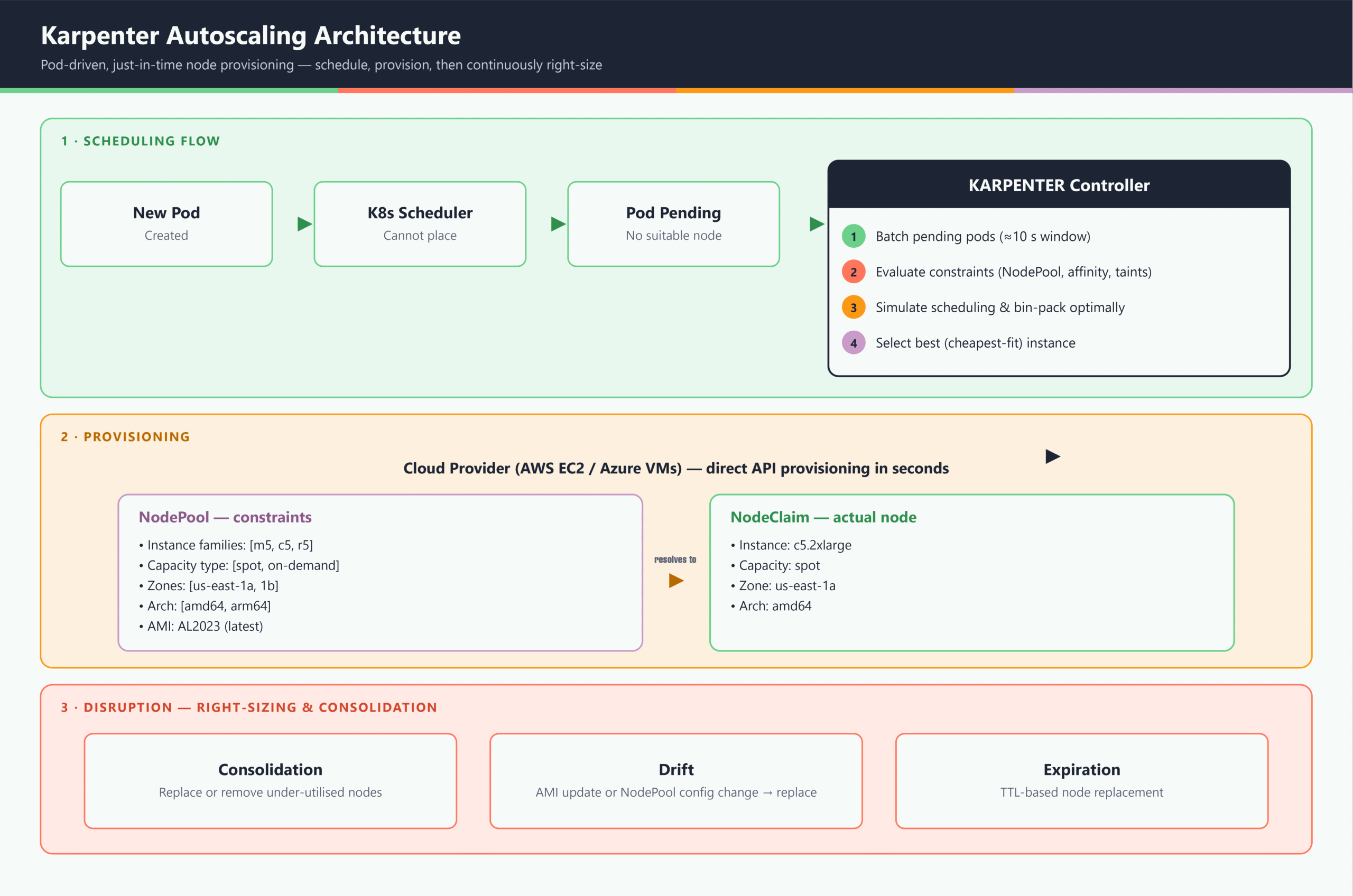
Architecture: Karpenter Just-In-Time Node Provisioning
Key Features of Karpenter
- Pod-driven, just-in-time provisioning — Karpenter reacts to actual pending pods rather than a scaling metric on a fixed group, so capacity is added only when it is genuinely needed and shaped to fit what’s pending.
- NodePools and NodeClasses (v1 API) — Declarative custom resources define which instance families, architectures, capacity types, zones, and node templates are allowed, giving platform teams guardrails without hand-managing individual node groups.
- Full-catalog, fleet-based instance selection — Rather than committing to one instance type, Karpenter evaluates the cloud provider’s entire eligible instance catalog in a single batched launch request and selects the cheapest shape that fits, across dozens of candidate types at once.
- Scheduling simulation and optimal bin-packing — Before provisioning, Karpenter simulates the Kubernetes scheduler’s placement decisions to pack multiple pending pods onto as few nodes as possible, minimizing wasted capacity from the moment a node comes online.
- Automatic consolidation — Underutilized or empty nodes are identified and replaced or removed on an ongoing basis, with configurable policies (empty-only, or empty-and-underutilized), so consolidation matches an organization’s risk tolerance.
- Drift detection and remediation — When a NodePool’s requirements, an AMI, or a launch template changes, Karpenter automatically detects the drift and replaces affected nodes, keeping the fleet aligned with the latest approved configuration without a manual patch cycle.
- Native Spot handling and interruption management — Karpenter launches Spot capacity natively, responds to interruption and rebalance-recommendation signals ahead of reclamation, and can automatically fall back to on-demand capacity to preserve availability.
- Disruption budgets and workload protection — Budgets cap how many nodes can be disrupted at once or during specific time windows, and a do-not-disrupt annotation protects sensitive pods from eviction during consolidation, drift, or expiration events.
- Node expiration (TTL-based rotation) — Nodes can be forced to roll on a defined lifetime, supporting security hygiene and configuration hygiene even on otherwise healthy, well-utilized nodes.
- NodeOverlays for pricing and accelerator shaping — Custom pricing signals and resource overlays let Karpenter make cost-aware decisions for GPU and other accelerator-backed workloads where list pricing alone doesn’t reflect real economics.
- Kubernetes-native and GitOps-friendly — Karpenter runs entirely as controllers and CRDs inside the cluster, with no separate control plane to manage, so NodePool definitions can be versioned, reviewed, and deployed through the same GitOps pipelines as any other workload.
- Growing multi-cloud reach — Generally available on AWS, integrated into Azure Kubernetes Service as Node Auto Provisioning, and extending to Google Kubernetes Engine through
Karpenter vs. Cluster Autoscaler
| Aspect | Cluster Autoscaler | Karpenter |
| Scaling Unit | Node Group (fixed instance type) | Individual nodes (any instance) |
| Instance Selection | Pre-defined in node group | Dynamic from full cloud catalog |
| Scaling Speed | Minutes (ASG + launch template) | Seconds (direct API provision) |
| Bin Packing | Basic | Optimal (multi-pod batching) |
| Consolidation | Not built-in | Automatic node consolidation |
| Spot Handling | Limited | Native spot + fallback to on-demand |
| Drift Detection | Not supported | Auto-replace drifted nodes (AMI, config) |
| Cost Optimization | Manual instance selection | Automatic cheapest-fit selection |
High-Level Use Cases
Use Case 1: Cost-Optimized Multi-Tenant Platform
A platform running 200 microservices uses Karpenter with diverse NodePools: one for general workloads (spot-preferred, arm64-preferred), one for GPU ML workloads, and one for compliance-sensitive workloads (on-demand only, specific AZs). Karpenter automatically selects the cheapest instance type that fits pending pods and consolidates underutilized nodes overnight.
Key Benefits:
- 40% cost reduction vs. Cluster Autoscaler (better bin-packing + spot)
- Provisioning time reduced from 3-5 minutes to 30-60 seconds
- Automatic consolidation saves 25% during off-peak hours
- Drift detection ensures nodes always run latest AMI (security compliance)
Use Case 2: Burst Scaling for CI/CD Pipelines
A development platform runs 500+ CI/CD pipelines daily using Karpenter. During peak hours, Karpenter provisions 100+ nodes in under 2 minutes. Each node is right-sized for the pipeline requirements (CPU-heavy for compilation, memory-heavy for integration tests). Nodes are terminated within 30 seconds of pipeline completion.
Key Benefits:
- Scale from 0 to 100+ nodes in under 2 minutes
- Right-sized instances for each pipeline type (no over-provisioning)
- Zero idle capacity — nodes terminated immediately after use
- Spot instances for 70% of CI/CD workloads (fault-tolerant by design)
How Digi edZe Enables Enterprises with Kubernetes Karpenter Autoscaling
Adopting Karpenter well is a platform engineering exercise, and it requires NodePool design tuned to real workload profiles, disruption policies that respect production risk tolerance, and a migration path off existing node groups that doesn’t interrupt running services. Digi edZe’s Kubernetes practice is built to carry enterprises through exactly that transition:
- Assesses and migrates from Cluster Autoscaler with zero-disruption cutover
- Designs NodePools around real workload economics
- Builds FinOps-aligned cost governance
- Hardens security and compliance by design
- Delivers one consistent model across clouds
- Instruments observability and FinOps reporting
- Supports adoption after go-live
Business Outcomes
- Compute spend brought down from the industry-typical 8% CPU / 20% memory utilization pattern toward right-sized, continuously bin-packed clusters
- Node provisioning time cut from minutes to under a minute for bursty and latency-sensitive workloads
- Up to 40% lower infrastructure cost versus Cluster Autoscaler-based clusters, with a further 20–40% available through arm64 adoption
- Continuous compliance through automated drift detection and TTL-based node rotation, without a manual patch cycle
- One consistent, GitOps-native autoscaling model across Amazon EKS and Azure Kubernetes Service
- Cost and utilization visibility platform teams and finance can both act on, through unified observability dashboards
Conclusion
Karpenter fundamentally changes Kubernetes autoscaling: instead of pre-defining node groups and hoping they fit, you describe constraints and let Karpenter find the optimal compute for your workloads in real-time. The combination of just-in-time provisioning, automatic consolidation, drift detection, and native spot support delivers better performance and lower cost than traditional autoscaling. Karpenter is the new default for any production of Kubernetes clusters.