

Oracle Container Engine for Kubernetes (OKE) is OCI’s managed Kubernetes service, offering both managed node pools (traditional VMs) and Virtual Nodes — a serverless compute option where pods run without customer-managed node infrastructure. Virtual Nodes, powered by OCI Container Instances, eliminate node scaling, patching, and capacity planning. Combined with OKE’s Cluster Add-ons (managed Istio, OCI Logging, Metrics Server), OCI delivers fully managed Kubernetes experience.
Reference Architecture: OKE with Virtual Nodes
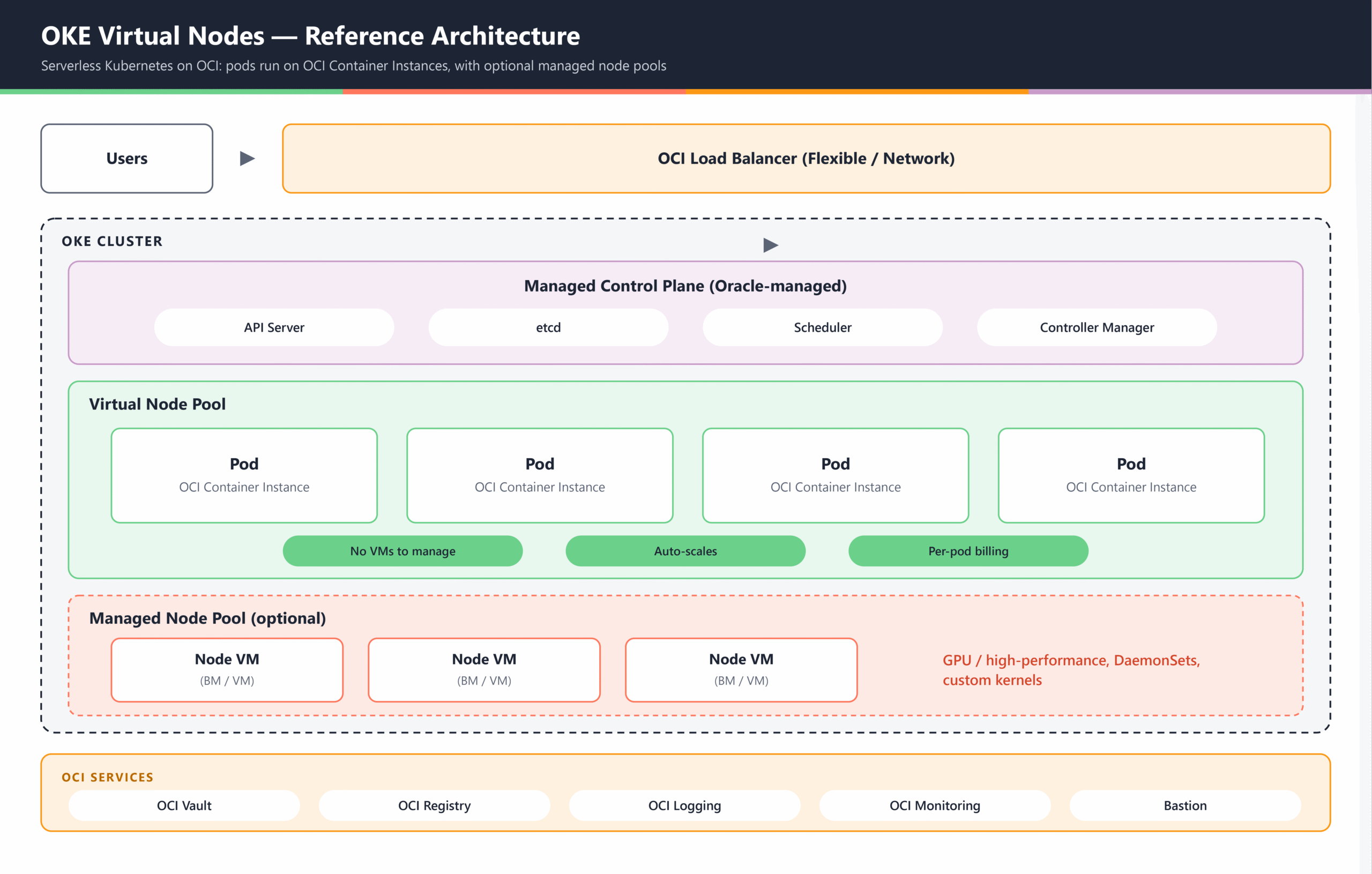
Key Facts
- Enhanced clusters only, running Kubernetes 1.25 or later.
- Pod-level resources: CPU and memory are defined in the pod spec, not on the node pool.
- Density: each virtual node supports up to 1,000 pods.
- VCN-native networking: every pod receives its own VCN IP, so NSGs and flow logs apply directly to pods.
- Autoscaling: use the Horizontal Pod Autoscaler; the Cluster Autoscaler is not supported.
Virtual Nodes vs. Managed Nodes
| Aspect | Virtual Nodes | Managed Nodes |
| Infrastructure | Serverless (no VMs) | Customer-managed VMs |
| Scaling | Automatic per-pod | Cluster Autoscaler / manual |
| Patching | Oracle-managed | Customer responsibility |
| Billing | Per-pod (vCPU + memory) | Per-VM (always on) |
| DaemonSets | Not supported | Fully supported |
| GPU Workloads | Not supported | Supported (A10, A100, H100) |
| Best For | Stateless microservices, batch | GPU, DaemonSets, custom kernels |
High-Level Use Cases
Use Case 1: Microservices Platform with Mixed Node Pools
A fintech company runs 50+ microservices on OKE. Stateless API services run on Virtual Nodes (zero node management, auto-scaling). ML inference services requiring GPU run on managed node pools with A10 shapes. Both pools share the same cluster, networking, and observability stack.
Key Benefits:
- Zero node management for 80% of workloads (Virtual Nodes)
- GPU node pools for ML inference only when needed
- Per-pod billing for Virtual Nodes — no idle capacity cost
- Unified service mesh (Istio add-on) across both pool types
Use Case 2: Batch Processing & Job Scheduling
A data processing company runs daily batch jobs (Kubernetes Jobs/CronJobs) on Virtual Nodes. Jobs spin up hundreds of pods in parallel, process data from Object Storage, and terminate. Virtual Nodes scale instantly without pre-provisioning — billing is strictly per-second of pod runtime.
Key Benefits:
- No capacity planning — Virtual Nodes scale to any burst
- Pay only for actual pod runtime (per-second billing)
- No idle nodes outside batch windows
- OCI Object Storage integration for data input/output
Best Practices with OKE Virtual Nodes on OCI
Availability
- Keep three virtual nodes per pool (the default), spread across availability domains, or fault domains in single-AD regions. Extra nodes add resilience, not capacity.
- Use topology spread constraints and affinity rules to distribute pods evenly.
Pod specifications
- Always set CPU and memory requests; on Virtual Nodes they are the only way to guarantee resources.
- Set requests equal to limits, since differing values are not supported.
- Choose the pod shape deliberately; Pod.Standard.E4.Flex, for example, allows up to 64 OCPUs and 1 TB of memory per pod.
Networking
- Size the pod subnet for growth: a /24 fits about 250 pods, while 4,000 pods need a /20.
- Route the pod subnet through a NAT gateway and a service gateway, not an internet gateway.
- Create load balancer security rules manually, including TCP 30000–32767 between the load balancer and pods.
- Restrict traffic with NSGs and inspect it with VCN flow logs.
Security
- Create the required IAM policy so OKE can attach pod VNICs to your subnets.
- Use Workload Identity to give pods least-privilege access to Object Storage or Vault.
- Place OCI WAF in front of the load balancer, and run containers as non-root with read-only root filesystems.
Operations
- Automate cluster creation with the Terraform or Resource Manager stack.
- Deploy Metrics Server using the virtual-node method in Oracle’s documentation.
- Troubleshoot with kubectl proxy, since exec, attach, and port-forward are unavailable.
Limitations to Plan For
- No DaemonSets, init containers, hostPath volumes, or privileged containers.
- No Istio or other service meshes, and no NetworkPolicy providers such as Calico or Cilium.
- No GPU or Intel pod shapes yet.
- Persistent volume claims work only with File Storage, not Block Volume.
- No SSH access, because there are no nodes to reach.
Best Practices & Recommendations
- Use Virtual Nodes for stateless microservices and batch workloads — no nodes to manage
- Use Managed Nodes for GPU workloads, DaemonSets, and custom kernel requirements
- Mix Virtual and Managed node pools in the same cluster for cost optimization
- Use OKE Cluster Add-ons for managed Istio, CoreDNS, and metrics server
- Implement OCI WAF in front of the OCI Load Balancer for application security
- Use OCI Vault (OCID) for Kubernetes secrets management via CSI driver
- Monitor pod performance with OCI Monitoring and the Kubernetes Metrics Server add-on
Conclusion
OKE Virtual Nodes bring the serverless paradigm to Kubernetes: no nodes to provision, patch, or scale — just deploy pods and pay per second of usage. Combined with managed node pools for specialized workloads (GPU, DaemonSets), OKE offers the flexibility to optimize both operational overhead and cost. For organizations looking to run Kubernetes without the toil of node management, Virtual Nodes are the answer.