

AI agents are the next step beyond chatbots and retrieval-augmented generation. Where a prompt-response system answers a question, an agent pursues a goal by reasoning about which steps are needed, executing them with tools such as APIs, databases, and code execution, observing the results, maintaining state across interactions, and adapting its approach, often in collaboration with other specialist agents.
The tooling around that idea has matured quickly. LangGraph was in durable state, checkpoint-based persistence, and first-class human-in-the-loop support. Microsoft released Agent Framework as the successor to both Semantic Kernel and AutoGen, which have moved to maintenance mode. Amazon Bedrock AgentCore became generally available as a framework- and model-agnostic runtime with identity, gateway, and observability services. Google unified its agent tooling under the Gemini Enterprise Agent Platform, succeeding Vertex AI. And in the Oracle ecosystem, Oracle AI Agent Studio for Fusion Applications and the OCI Agent Developer Kit — paired with the Oracle Autonomous AI Database MCP Server — now put agents directly on top of the enterprise system of record.
Underneath all of it, open standards are converging. Anthropic donated the Model Context Protocol (MCP) to the Linux Foundation’s Agentic AI Foundation, with more than 10,000 active public MCP servers and support across major clouds and AI products, while the Agent2Agent (A2A) protocol lets agents built on different frameworks collaborate. The implication is significant: building an agent is becoming a commodity. Running one safely, auditably, and economically is not.
Agent Design Patterns
Choosing the right pattern is the first architectural decision, and the simplest pattern that solves the problem is almost always the right one.
| Pattern | Description | Best fit | Trade-off to plan for |
| ReAct | Reason → Act → Observe loop | Simple tool-using agents | Can loop without a hard stop |
| Plan-and-Execute | Plan all steps first, then execute | Complex multi-step tasks | Plans can break when early assumptions fail |
| Reflection | Agent critiques its own output and iterates | Quality-sensitive generation | Extra latency and token cost |
| Multi-Agent Debate | Multiple agents argue toward consensus | Decision-making and analysis | Highest cost per answer |
| Supervisor | Manager agent delegates to specialists | Workflows needing diverse skills | The supervisor becomes a bottleneck |
| Swarm | Agents hand off to each other based on context | Customer support and routing | Harder to trace end to end |
Reference Architecture: A Governed Multi-Agent System
In a well-designed multi-agent system, an orchestrator agent analyzes the request, breaks it into sub-tasks, delegates them to specialist agents, evaluates what comes back, and either iterates or synthesizes a final response. Each specialist owns a narrow set of tools and its own memory. What separates a production system from a prototype is the layer around those agents: a registry of approved tools, shared memory, guardrails that bound what agents may do, and a governance plane that records everything they did.
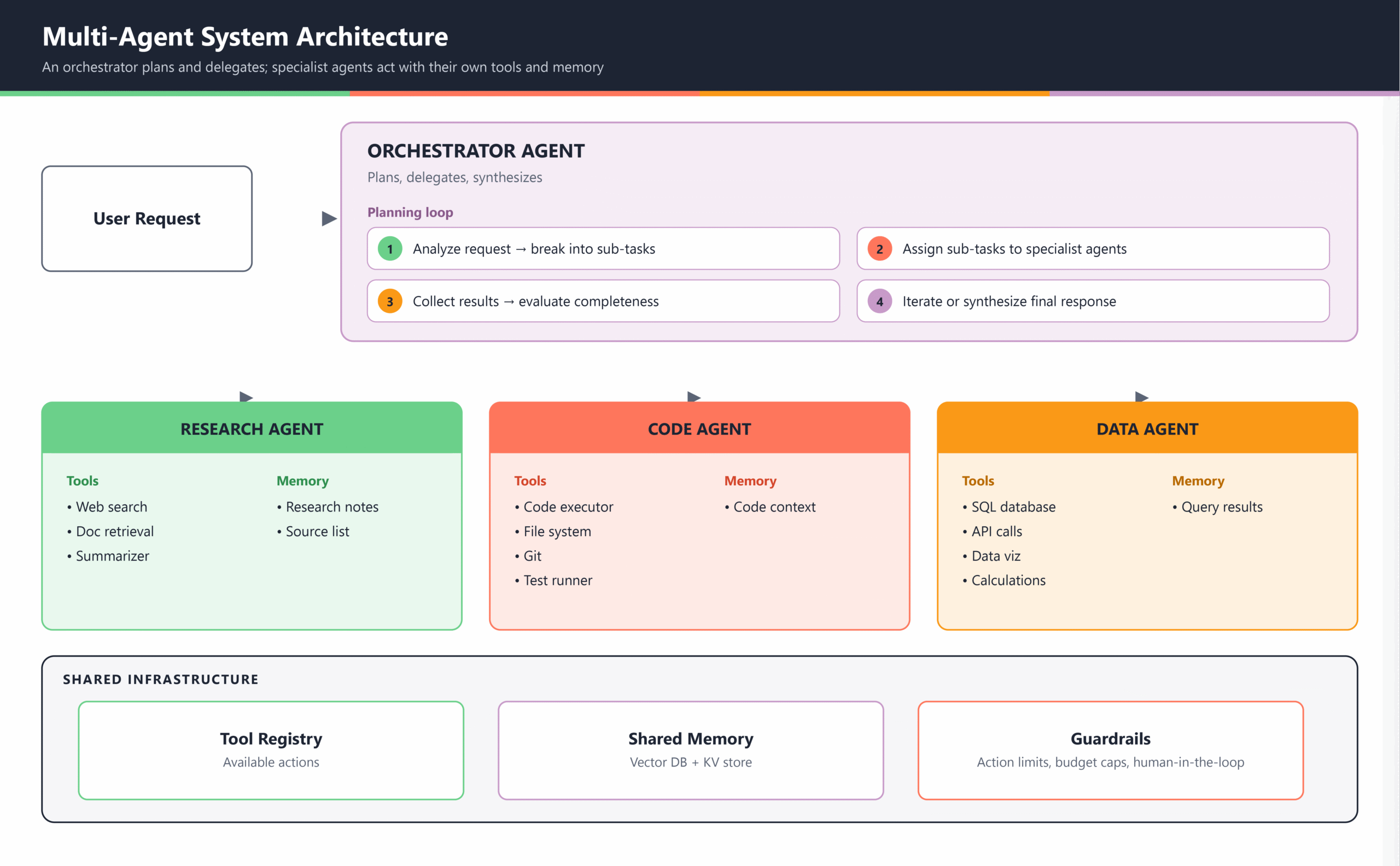
Two lessons stand out. First, the framework is increasingly the most reversible decision in the stack: with MCP for tools and A2A for agent collaboration, agent assets are becoming portable, and teams that built on AutoGen or Semantic Kernel now face a planned migration rather than a rewrite. Second, the decisions that are not reversible — identity, data access, approval policy, audit — sit above the framework, and that is where enterprise value and enterprise risk are concentrated.
Where Agents Fail and What Contains It
Agents fail in predictable ways. Each failure mode has a known engineering control; the work is applying all of them consistently.
| Failure mode | What happens | Control |
| Runaway loops | The agent retries or re-plans until cost or time is exhausted | Budget caps on tokens, API calls, and wall-clock time |
| Hallucinated tool parameters | The agent calls a real API with invented arguments | Schema-validated tool contracts and carefully written tool descriptions — they are the agent’s API documentation |
| Irreversible actions | A payment, a merge, or a deletion cannot be undone | Action allowlists, least-privilege agent identities, and human-in-the-loop checkpoints |
| Lossy hand-offs | Meaning degrades as agents pass free text to each other | Structured output (JSON schema) for agent-to-agent communication |
| Invisible failures | Nobody can explain why the agent did what it did | Full step-level tracing and logging, such as LangSmith or equivalent |
| Adversarial inputs | Prompt injection or manipulated content steers the agent | Adversarial testing, aligned to the OWASP Top 10 for Agentic Applications |
High-Level Use Cases
Use Case 1: Automated Software Engineering Agent
A development team deploys a code agent, built on LangGraph, that receives bug reports, searches the codebase for relevant files, writes a fix, runs the tests, and opens a pull request. A separate review agent evaluates the pull request for code quality and potential regressions. Human developers review and merge — keeping a human quality gate before anything reaches production.
Key benefits:
- Average bug-fix time reduced from roughly two days to two hours
- Agent handles about 60% of routine bugs end to end
- Review agent catches about 85% of the issues human reviewers would flag
- Human-in-the-loop approval remains the gate before merge
Use Case 2: Multi-Agent Research & Analysis Platform
An investment firm deploys a multi-agent system for market analysis. A Research Agent gathers news and filings, a Data Agent queries financial databases and generates charts, a Risk Agent evaluates exposure, and an Orchestrator synthesizes a comprehensive investment brief. Each agent has domain-specific tools and memory.
Key benefits:
- Research briefs generated in about 15 minutes, down from roughly four hours
- Multi-source analysis that individual analysts often miss
- Consistent format and depth across every research output
- A complete audit trail of every data source and reasoning step — essential in a regulated environment
Use Case 3: Governed Agents on the Enterprise System of Record
A finance shared-services team uses Oracle AI Agent Studio to build agents that triage invoice and procurement exceptions inside Oracle Fusion Applications, and OCI-hosted agents that query Autonomous AI Database through its MCP server using read-only tools the team has defined. Agents work on live system-of-record data rather than copies, inherit the database’s existing role-based access and auditing, and route anything that changes a financial record to a named approver.
Key benefits:
- Routine exception handling moves from inboxes and spreadsheets into an auditable workflow
- Agents inherit the security model of the system they act on instead of bypassing it
- Per-agent measurement of time and cost saved, so value is demonstrated rather than assumed
- Human approval retained for every action that changes a financial record
How Digi edZe Enables Enterprises with Agentic AI
Standing up an agent is a weekend project. Making it reliable, secure, and accountable enough to run a business process is an engineering program, and that is where Digi edZe’s AI and cloud practice works with enterprises:
- Starts with the workflow
- Designs the autonomy boundary deliberately
- Engineers’ reliability into the build
- Builds on the system of record
- Delivers across clouds without lock-in
- Instruments observability and audit
- Tests like an adversary
- Supports adoption after go-live
Business Outcomes
- Cost under control — runaway agent spend prevented by budget caps, with cost per task visible to engineering and finance alike
- Value proven — outcomes measured per agent and per workflow, so investment follows results
- Risk contained — high-stakes actions gated by human approval, least-privilege identity, and action allowlists
- Audit-ready by design — a complete record of every data source, tool call, and reasoning step
- Faster, more consistent knowledge work — engineering, research, and finance workflows completed in hours or minutes rather than days
- Portable investments — agent assets built on open standards that survive changes in frameworks and platforms
Best Practices & Recommendations
- Start with a single agent. ReAct design for simple tool use; add multi-agent orchestration only when task complexity demands it.
- Implement human-in-the-loop checkpoints for high-stakes actions such as financial transactions and code merges.
- Set budget caps — token limits, API call limits, and time limits — to prevent runaway agent loops.
- Use structured output (JSON schema) for agent-to-agent communication; natural language is lossy.
- Write tool descriptions carefully — they are the agent’s API documentation.
- Grant each agent its own least-privilege identity and an explicit action allowlist.
- Log every agent step and use tracing such as LangSmith or an equivalent for full execution visibility and audit.
- Test agents with adversarial inputs to find and fix failure modes before go-live, using the OWASP Top 10 for Agentic Applications as a checklist.
- Prefer open standards — MCP for tools, A2A for agent collaboration — to keep agent assets portable across frameworks and clouds.
- Plan migrations deliberately: if you run AutoGen or Semantic Kernel, both are now in maintenance mode, with new development moving to Microsoft Agent Framework.
Conclusion
AI agents mark a shift from AI as a tool — ask a question, get an answer — to AI as a collaborator: describe a goal, and the agent works to achieve it. The frameworks and managed services available in 2026 have made building agents tractable; the hard part is reliability. Agents can loop, hallucinate tool parameters, or make irreversible mistakes, so production systems must pair guardrails — budget caps, human-in-the-loop approval, action allowlists — with full execution observability. Digi edZe brings the architecture discipline, Oracle and multicloud depth, and governance practices to turn agentic AI from a promising pilot into an accountable part of how an enterprise operates.