

Most enterprises do not have a monitoring problem. They have an interpretation problem.
Workloads sit across on-premises data centres, OCI, AWS, Azure and GCP. Each platform ships its own console, its own alerting model and its own security view. Teams end up with a dozen dashboards, tens of thousands of alerts a month, and no single answer to the two questions that decide whether IT is doing its job: Is it up? Is it secure?
A Network Operations Center (NOC) answers the first question. A Security Operations Center (SOC) answers the second. This article explains how the two work together to make multi-cloud operations seamless and efficient, and where the digi edZe NOC, stands apart from the typical managed service.
Why Multi-Cloud Strains Traditional IT Operations
Multi-cloud delivers choice and resilience, but it multiplies the surface that operations teams must watch. Three problems show up in almost every enterprise:
- Fragmented visibility — Every cloud has its own monitoring console, metrics and alert format, so no one sees the whole estate in one place.
- Alert overload — Thousands of low-value alerts bury the few that matter, and engineers spend shifts acting as a human alert queue.
- Slow, siloed response — When an incident crosses clouds, platform, database and application teams each investigate their own layer and the root cause surfaces late.
A NOC and a SOC, run well, are the answer to all three. Each gives the estate a single point of operational accountability, one for availability and one for security.
Two Centres, Two Questions
The NOC and SOC are often mentioned in the same breath, but they work on different problems and are measured against different outcomes. Together they cover the whole of operational resilience.
| NOC — Network Operations Center | SOC — Security Operations Center | |
| The question it answers | Is it up, and is it performing? | Is it secure? |
| Focus | Availability, performance, capacity and SLAs | Threats, vulnerabilities, access and compliance |
| Day-to-day work | Monitoring, incident and problem management, capacity planning, reporting | Threat detection, incident response and forensics, threat hunting, audit evidence |
| What failure looks like | Downtime, slow applications, breached SLAs | A breach, exposed data, a failed audit |
| The multi-cloud challenge | Many consoles and alert models, one estate to keep running | Many security tools and log formats, one risk posture to defend |
How the NOC Makes Multi-Cloud Seamless
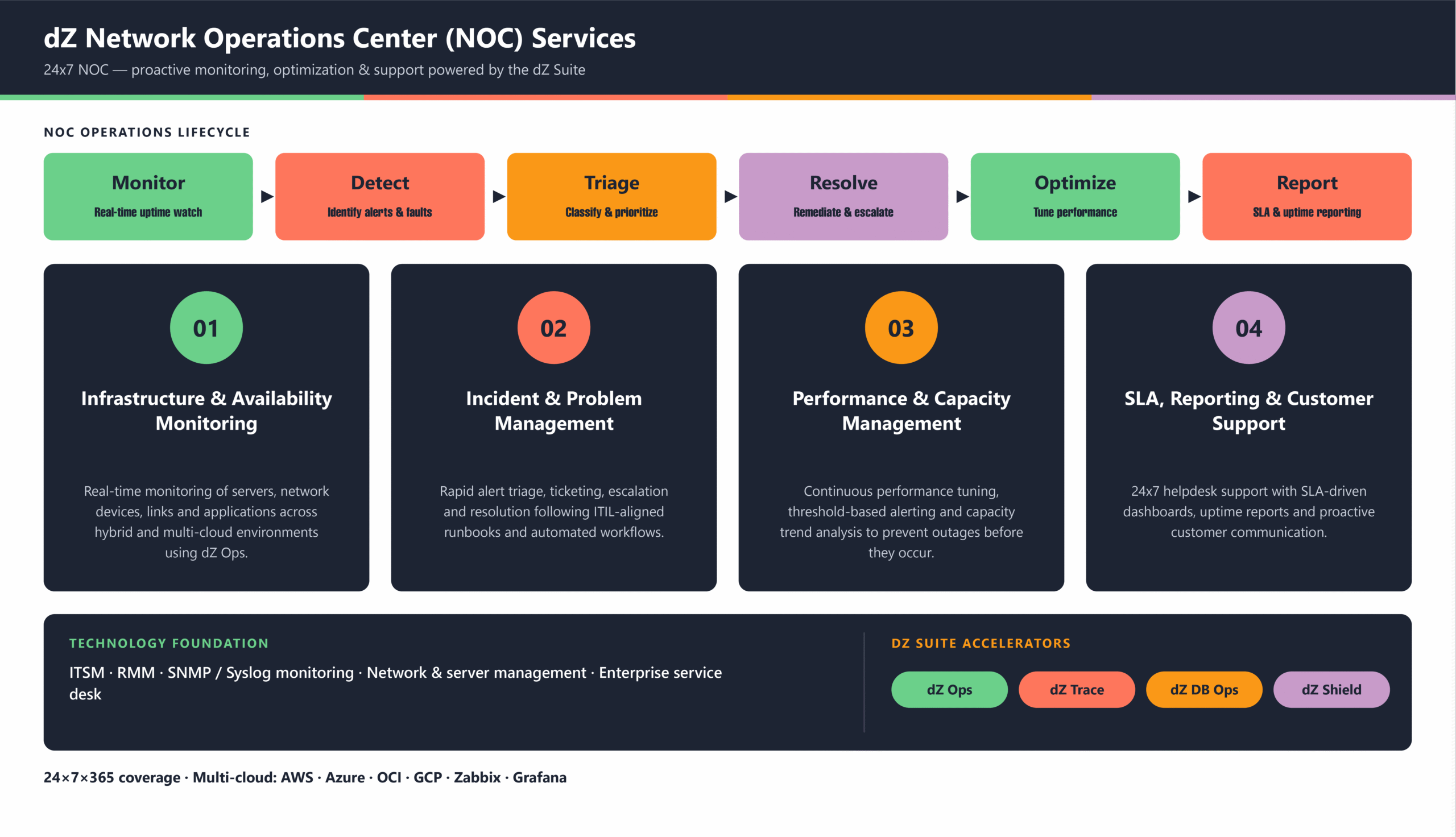
The digi edZe NOC provides 24x7x365 proactive monitoring, optimization and support across hybrid and multi-cloud environments, following a disciplined lifecycle: Monitor → Detect → Triage → Resolve → Optimize → Report.
What the NOC covers
- Infrastructure and availability monitoring — Real-time monitoring of servers, network devices, links and applications across hybrid and multi-cloud estates, using dZ Ops alongside native tooling and Zabbix, Grafana, Nagios, Prometheus and the ELK stack.
- Incident and problem management — Rapid alert triage, ticketing, escalation and resolution following ITIL-aligned runbooks and automated workflows.
- Performance and capacity management — Continuous tuning, threshold-based alerting and capacity trend analysis that prevent outages rather than report them.
- SLA, reporting and support — A 24×7 helpdesk with SLA-driven dashboards, uptime reports, cost reports and proactive customer communication.
One team across every cloud
A single NOC and a single operating model span on-premises data centres, OCI, AWS, Azure and GCP, including Kubernetes and EKS platforms. There is no separate provider per cloud and no hand-off between consoles when an incident crosses platforms. An L1 Command and Control Centre team operates 24×7 for service desk, event monitoring, incident logging, initial triage and escalation.
Behind it, sits dedicated L2/L3 towers for cloud operations, platform operations, database operations, monitoring and observability, backup and DR, automation and DevOps, and governance and service management, each staffed by certified specialists rather than a shared generalist pool.
Open, vendor-neutral tooling
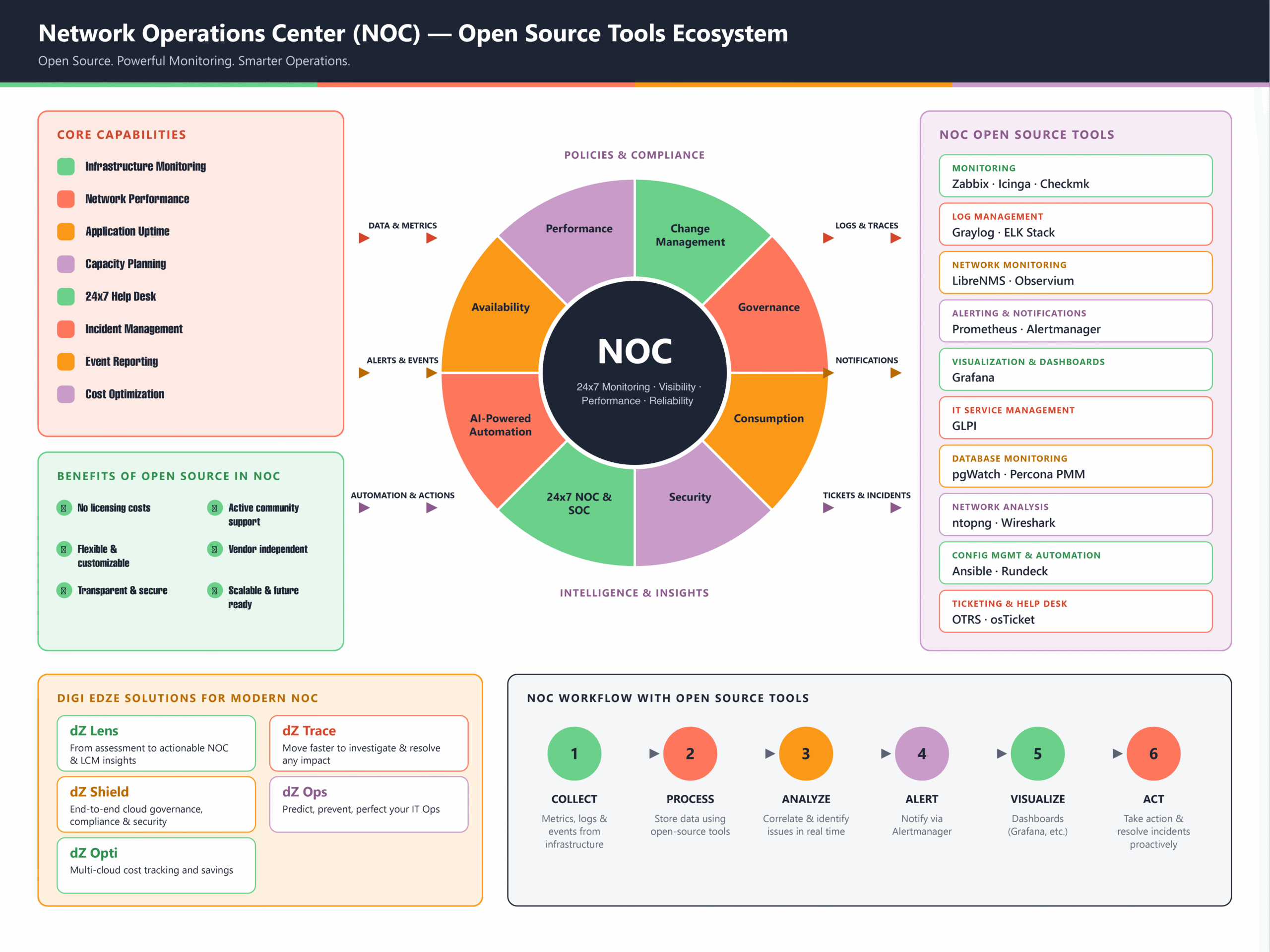
Alongside dZ Ops and dZ Trace, the NOC runs on proven open-source monitoring tools such as Zabbix, Grafana, Prometheus, the ELK stack, Graylog and Nagios. That means no licence fees for the monitoring layer, no lock-in to a single monitoring vendor, and a NOC that works with the tooling you already have rather than demanding you replace it.
Transparency built in
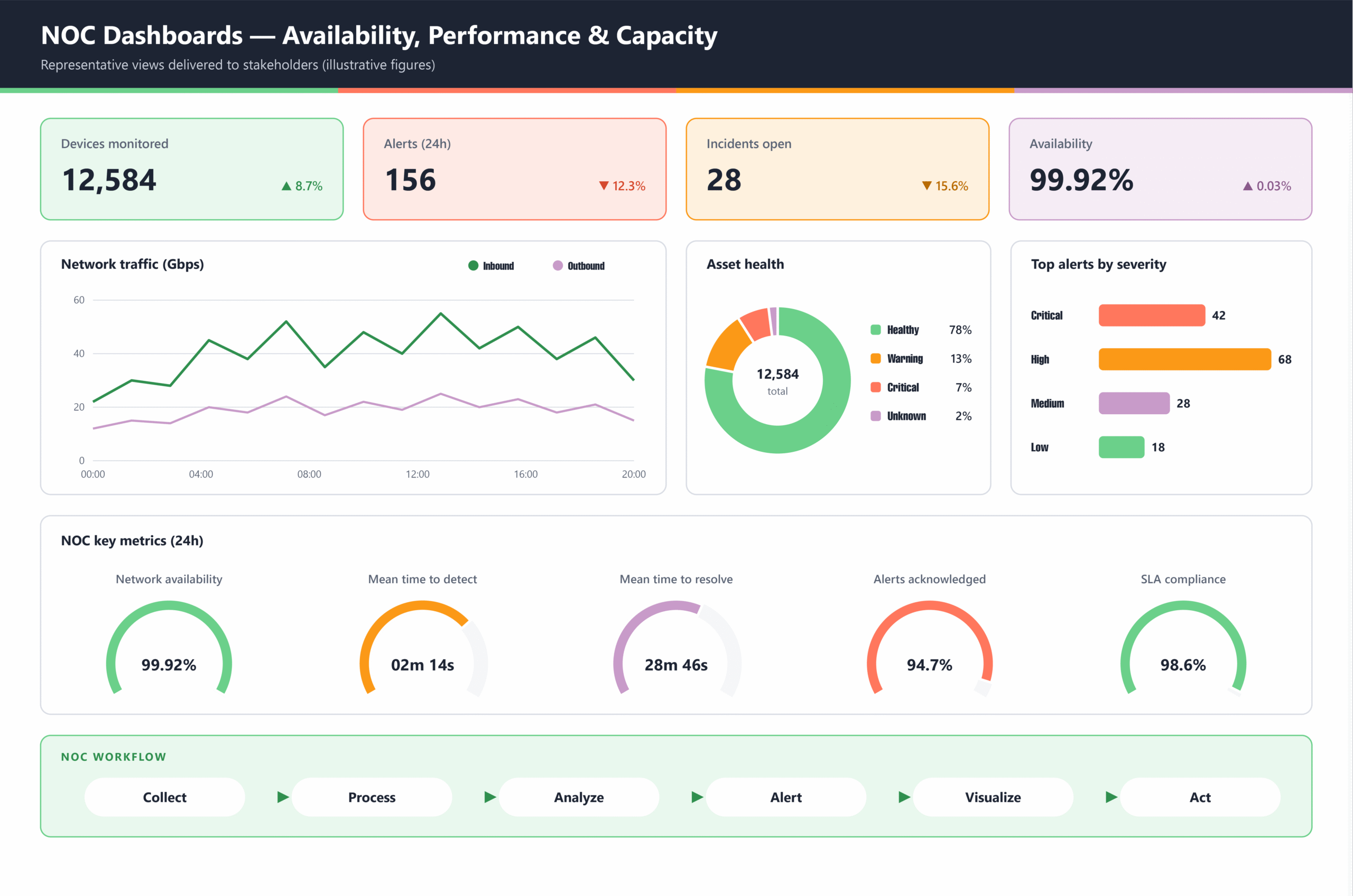
Customers see the work through SLA-driven dashboards, uptime and cost reports and proactive communication. dZ Trace adds immutable audit logs for every alert and policy action, aligned to SOC 2 and ISO 27001.
How the NOC Makes Multi-Cloud Efficient
Seamless coverage is only half the value. The other half is how little human effort it takes to run. The digi edZe NOC is built so that automation absorbs the routine and people handle what needs judgement.
Automation first, so people work on what matters
The NOC runs on dZ Ops, our AIOps engine. Autonomous agents detect issues, correlate alerts, forecast capacity and execute runbooks, patching and configuration changes without waiting for a human to pick up a ticket. The result is up to 90% of incidents auto-resolved, 95% of alert noise eliminated through correlation, and more than 80% of routine operations automated end to end.
What this changes for the customer: your engineers stop being an alert queue. The volume that used to consume an L1 shift is absorbed by automation, and skilled people are freed for engineering work that moves the business.
Root cause in seconds, not war-room hours
dZ Trace unifies traces, metrics and logs in one platform, with AI-driven root cause analysis, distributed tracing and dependency mapping across cloud-native, Kubernetes and on-premises systems. Mean time to root cause is under 30 seconds, against hours with traditional triage.
What this changes for the customer: the war-room call where four teams argue about whose layer is at fault largely disappears. RCA arrives before the escalation does.
Specialist depth where skills are scarce
Databases are where most performance incidents ultimately land. The NOC’s Database Operations tower covers Oracle, SQL Server, MySQL and PostgreSQL, and dZ DB Ops cuts manual DBA effort by 60–70% with continuously validated backups and zero-downtime patching.
What this changes for the customer: database expertise stops being a single point of dependency, and patching stops being a weekend outage negotiation.
How the SOC Protects Multi-Cloud Operations
A NOC keeps services running. A SOC makes sure they are running safely. In a multi-cloud estate, its job is to pull security signals out of every platform and turn them into a single, prioritized view of risk. A mature SOC typically provides:
- 24×7 threat monitoring and detection — Continuous correlation across cloud, endpoint, network and identity data, usually through SIEM, UEBA and XDR tooling.
- Incident response and forensics — Rapid triage, containment and eradication, supported by automated playbooks and root-cause investigation.
- Threat intelligence and hunting — Proactive searches for attacker behaviour, commonly mapped to the MITRE ATT&CK framework.
- Compliance and reporting — Audit-ready evidence for frameworks such as ISO 27001, SOC 2, GDPR and PCI-DSS.
Multi-cloud makes this harder, because AWS, Azure, OCI and GCP each have their own native security services and log formats. That is why the SOC’s value comes from consolidation: one team, one risk picture, many clouds.
SOC and NOC for Seamless Cloud Infrastructure Management
The two centres are strongest when they share information instead of working in parallel. A spike in outbound traffic, a run of failed logins or an unexpected configuration change looks like an operational anomaly to the NOC and a possible attack to the SOC. The NOC’s ITIL-aligned ticketing and escalation give security-relevant events a clear path to the team that owns detection and response.
The digi edZe NOC also supports security teams with dZ Shield, an agentless cloud security posture management platform. It scans AWS, Azure, GCP, OCI, Kubernetes and Microsoft 365 against best practice, flags IAM sprawl, drift and misconfiguration, and maps every finding to frameworks including CIS Benchmarks, NIST, PCI-DSS, GDPR, HIPAA, SOC 2 and ISO 27001. Whoever owns security in your organisation gets continuous, audit-ready posture data from the same estate the NOC is already running.
Where the digi edZe NOC Stands Apart?
Plenty of providers offer a 24×7 NOC. What differs is how the work gets done. In short:
- Automation first: dZ Ops resolves up to 90% of incidents automatically and removes 95% of alert noise.
- Root cause in under 30 seconds: dZ Trace replaces the hours-long war room with AI-ranked answers.
- Specialists, not a generalist pool: An L1 command centre backed by dedicated L2/L3 towers, including database operations.
- Native to hybrid and multi-cloud: One team and one operating model across on-premises, OCI, AWS, Azure and GCP.
- Open and vendor neutral: Proven open-source tooling means no monitoring licence fees and no lock-in.
- Proprietary and accountable: The NOC is built on products digi edZe designs and owns, so the people running the service and the people building its tooling sit in the same company.
Conclusion
A NOC answers with continuous monitoring, fast resolution and SLA reporting, and digi edZe’s AI-first NOC does it across every cloud with a fraction of the manual effort. A SOC answers with 24×7 detection, response and compliance evidence. Multi-cloud operations are seamless and efficient when both questions have an owner, and the two teams share what they see.