

1
public endpoint for all models
2
demo pools: CPU and GPU
7
routing stages per request
90
day pilot proposed
IN THIS POST
Why LLM Traffic Needs a Smarter Front Door?
Traditional load balancers are excellent for web traffic. They ask one question: “Is this server healthy?” LLM workloads break that model.
Two inference servers can expose exactly the same OpenAI-compatible API and still differ enormously: one sits on a GPU, the other on CPUs; one is idle, the other has a long queue of tokens to generate; one already holds the cached context for this conversation. Sending requests round-robin wastes expensive GPU time and makes response times unpredictable for users.
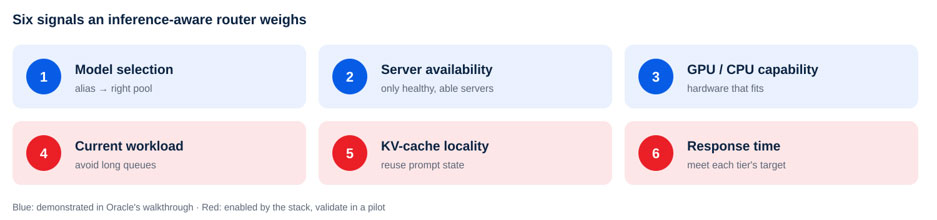
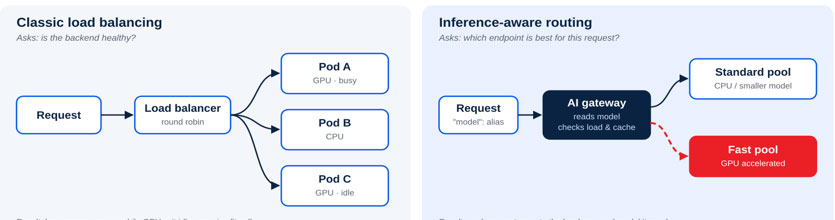
We are moving from “Which server is healthy?” to “Which inference endpoint is best suited for this request?”
WHAT THIS MEANS FOR MANAGEMENT
As our customers move GenAI from pilot to production, GPU spend becomes the largest line item. A routing layer that understands models is the control point for both cost and user experience, and it is now available on OKE using open standards rather than a proprietary gateway.
What Oracle Has Built on OKE?
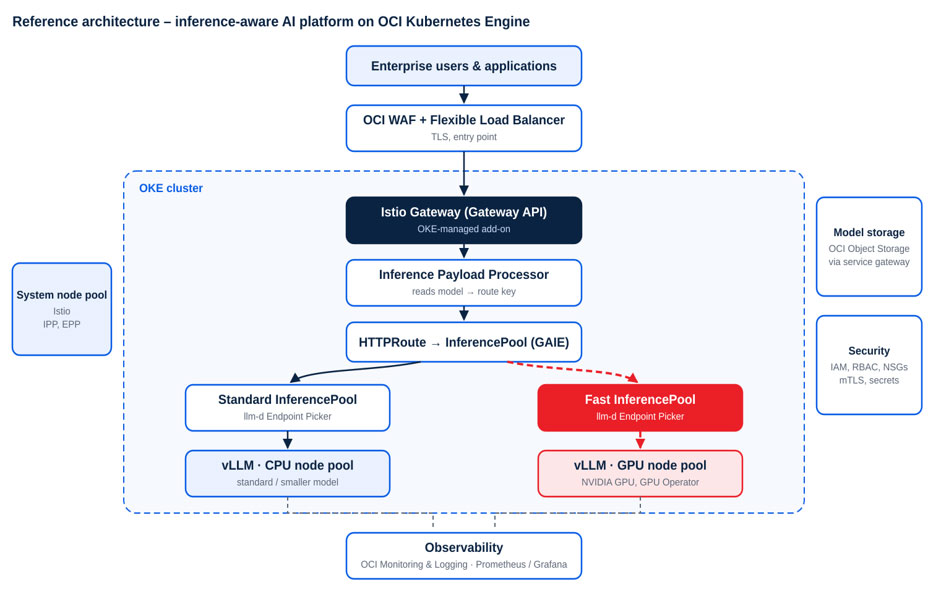
Oracle’s product team built a deliberately small but complete reference: a single model, Google’s Gemma 4 E2B, served on two very different backends behind one public gateway. Every component is open source or an OKE-managed add-on.
Bill of materials
| Component | Role | Version used |
| Kubernetes on OKE | Cluster platform | v1.36.1 |
| Gateway API (CRDs) | Standard Kubernetes traffic-entry API | v1.6.1 |
| Gateway API Inference Extension | InferencePool and the Endpoint Picker contract | v1.6.0 |
| llm-d Router | Endpoint Picker (EPP), one per pool | v0.10.0 |
| llm-d Inference Payload Processor | Reads the model from the request body | v0.1.0 |
| OKE-managed Istio add-on | Gateway data plane with GAIE support switched on | Managed |
| NVIDIA GPU Operator | GPU drivers and device plugin | v25.10.1 |
| vLLM | Model server, CPU and GPU images | v0.26.0 |
Three node pools, three jobs
| Node pool | Label | What runs there |
| System | workload-class=system | Istio gateway, Inference Payload Processor, both Endpoint Pickers |
| Standard | workload-class=standard | CPU-only vLLM server |
| Fast | workload-class=fast | vLLM on an NVIDIA A10 GPU |
Follow One Request, Step-by-Step
The clever part is how a plain chat request turns into a precise routing decision. The client only names a model alias. Everything else is added by the platform along the way:
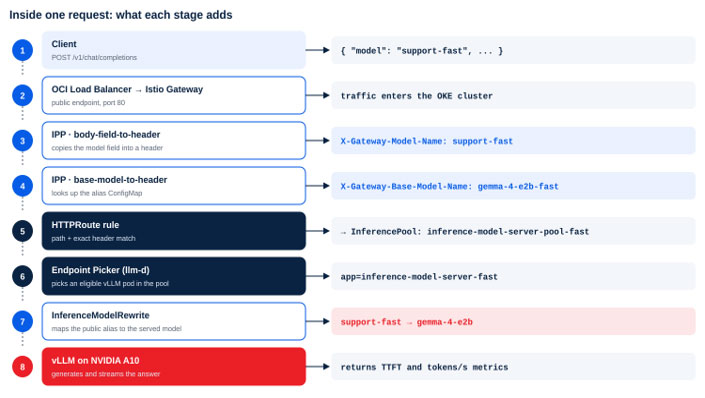
POST /v1/chat/completions
{ “model”: “support-fast”,
“messages”: [{ “role”: “user”,
“content”: “Summarise this P1 incident and suggest the root cause.” }] }
| Client asks for | IPP adds header | Routed to pool | Model actually served |
| support-standard | gemma-4-e2b-standard | Standard pool (CPU) | gemma-4-e2b |
| support-fast | gemma-4-e2b-fast | Fast pool (A10 GPU) | gemma-4-e2b |
Headers used: X-Gateway-Model-Name (copied from the body) and X-Gateway-Base-Model-Name (looked up from the alias map). The HTTPRoute matches on the second header for the paths /v1/completions and /v1/chat/completions.
▶ Play a request through the pipeline
Pick an alias and watch each stage light up in our interactive simulator.
WHAT THIS MEANS FOR MANAGEMENT
Applications never change when we move a model, add a GPU pool or swap a model version. We change a mapping on the platform. That is what makes tiered pricing, canary releases and vendor-neutral model choice practical.
Same Model, Two Price/Performance Profiles
Both pools serve the identical model. What differs is the hardware and how much work each server accepts at once:
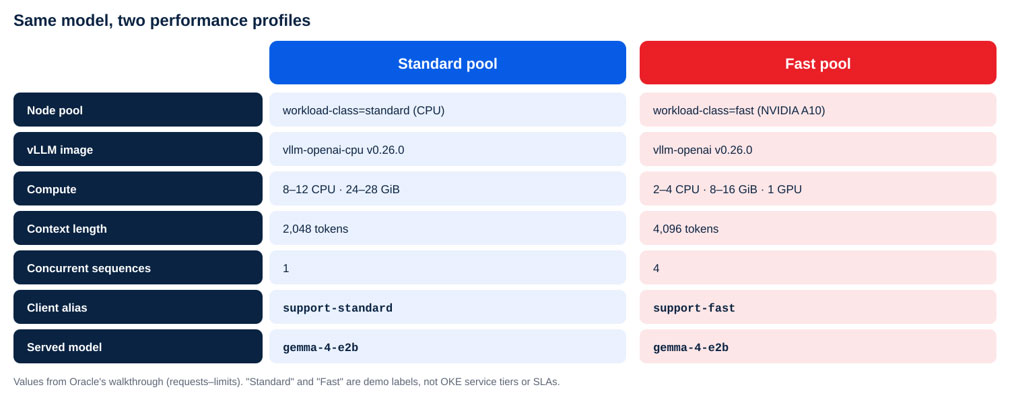
📊 Standard pool
- Cheaper CPU capacity
- One request at a time, 2,048-token context
• Good for batch, background and simple Q&A
⚡ Fast pool
- One NVIDIA A10 GPU
- Up to four sequences, 4,096-token context
• For interactive, latency-sensitive work
Read the labels carefully
Oracle states that “Standard” and “Fast” are demo labels, not OKE performance tiers or guarantees, and that results vary by model, hardware, workload and configuration. Our own pilot must produce our own numbers.
Who Does What: A Clean Separation of Responsibilities
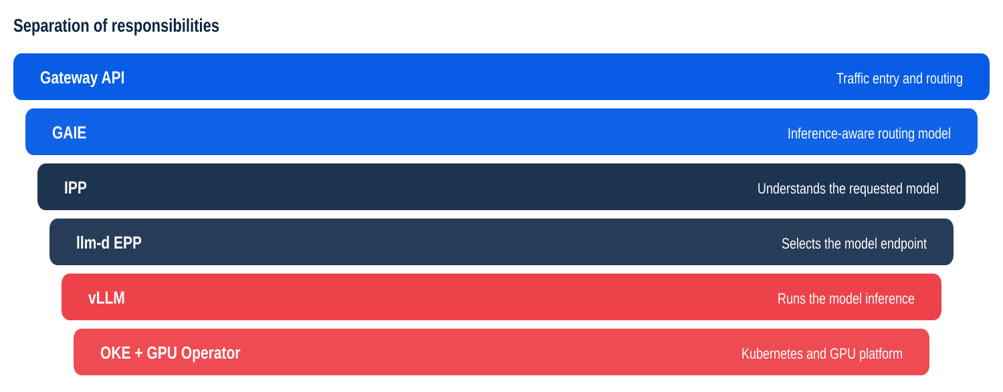
| Layer | Responsibility | Who owns it for us |
| Gateway API | Traffic entry and routing rules | Platform team |
| GAIE | Inference-aware routing model (InferencePool, picker contract) | Platform team |
| IPP | Reads which model the client asked for | Platform team |
| llm-d EPP | Chooses the best endpoint inside a pool | Platform / AI ops |
| vLLM | Runs the model and streams tokens | AI engineering |
| OKE + GPU Operator | Kubernetes, nodes, GPU drivers | Cloud operations |
Kubernetes ingress is evolving from traffic routing into AI-aware workload routing. |
Technical Deep Dive for Our Architects
Oracle’s guide follows a clear order. Our summary of the thirteen steps, grouped into five stages:
| Stage | Steps in Oracle’s guide | Key detail |
| 1. Prepare nodes | Label workers; enable Node Feature Discovery and pin the NVIDIA GPU Operator | GPU Operator replaces the default NVIDIA device-plugin add-on |
| 2. Install APIs | Apply Gateway API, GAIE and llm-d CRDs; enable the OKE-managed Istio add-on | Two Istio flags: SUPPORT_… and ENABLE_GATEWAY_API_INFERENCE_EXTENSION |
| 3. Gateway | Create istio-ingress and a public Gateway (port 80) pinned to the system pool | Wait for condition Programmed |
| 4. Model servers | Create inference-model-server; deploy CPU and GPU vLLM with Services | GPU pod requests nvidia.com/gpu: 1 |
| 5. Routing | Install llm-d Router chart twice (one per pool), alias ConfigMaps, InferenceModelRewrite, HTTPRoute, then the IPP chart | Pickers and IPP patched onto the system pool; pools set to FailOpen |
A routing rule in plain form (our simplified illustration, not Oracle’s manifest):
# HTTPRoute rule (illustrative)
match: path /v1/chat/completions
header X-Gateway-Base-Model-Name = gemma-4-e2b-fast
send → InferencePool inference-model-server-pool-fast
FailOpen, explained
If the Endpoint Picker is unavailable, the gateway still forwards traffic to the pool instead of rejecting it. Good for availability; in production we decide per pool whether failing open or closed is the right business choice.
Version discipline
Gateway API, GAIE and llm-d are moving quickly. We pin versions, validate every manifest against what we install, and manage them through GitOps rather than copying YAML from blogs.
How Oracle Proves It Works?
The guide does not stop at “it deployed”. It checks each layer and then measures real requests:
| Check | What “good” looks like |
| GPU add-ons | Node Feature Discovery and GPU Operator pods running; GPU node shows allocatable nvidia.com/gpu |
| Gateway | Status Programmed |
| Model servers | Health endpoint answers; /v1/models lists gemma-4-e2b |
| HTTPRoute | Accepted, ResolvedRefs and Programmed all True |
| End to end | Test requests to support-standard and support-fast both succeed |
The four numbers that matter
| Metric field | Plain meaning | Why management cares |
| time_to_first_token_ms | How long before the answer starts appearing | Perceived speed for chat users |
| tokens_per_second | How fast the answer streams | Throughput, so cost per request |
| completion_tokens | Length of the generated answer | Normalises cost and speed comparisons |
| client_total_seconds | End-to-end wall-clock time | The user’s real experience |
WHAT THIS MEANS FOR MANAGEMENT
These are the same four measures we propose as pilot KPIs. They let us state cost per request and latency per tier with evidence, which is what customers will ask us for.
Business Value: A Worked Use Case
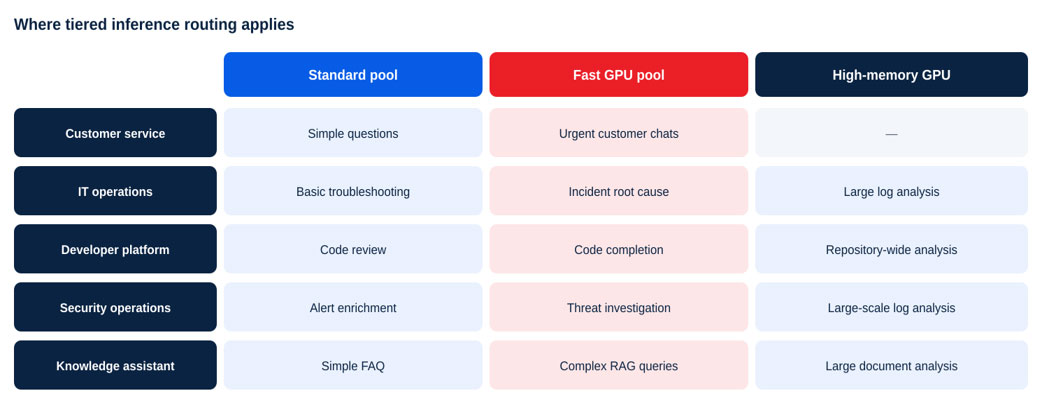
Use case: an AI-assisted IT service desk
Imagine a customer’s service desk assistant built on one internal endpoint. Every request says only which alias it wants:
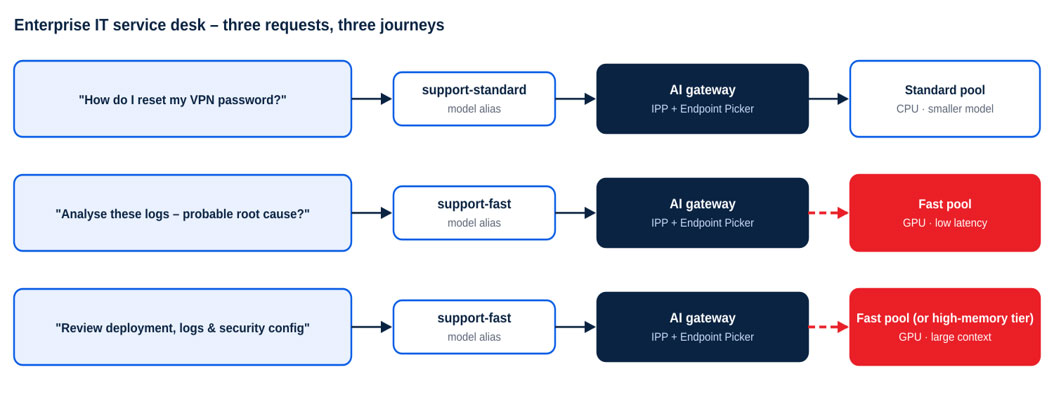
| Request | Alias | Route | Why |
| “How do I reset my VPN password?” | support-standard | CPU pool | Short, common, no urgency |
| Nightly summary of 2,000 closed tickets | support-standard | CPU pool | Batch; finishing overnight is fine |
| “Summarise this P1 outage and suggest root cause” | support-fast | GPU pool | Live incident; every second counts |
Illustrative cost effect
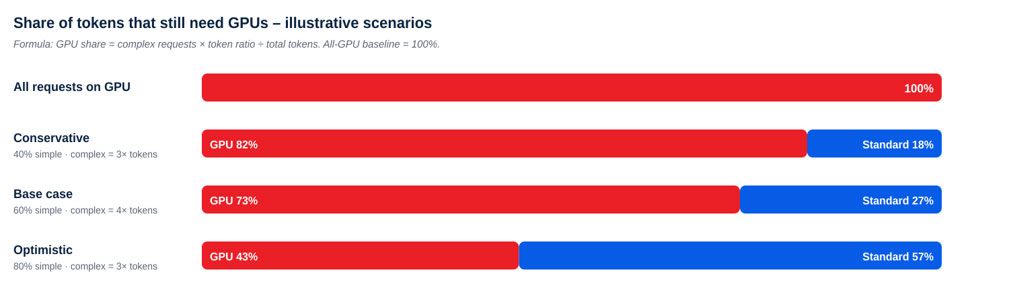
If a share s of requests can run on CPU and GPU time costs r times CPU time per token, the GPU’s share of serving cost falls as below. These are illustrative scenarios, not measurements:
| Scenario | Requests on Standard (s) | GPU cost ratio (r) | GPU share of token cost |
| Conservative | 40% | 3× | 82% |
| Balanced | 60% | 4× | 73% |
| Aggressive | 80% | 3× | 43% |
Formula: GPU share = (1−s)·r ÷ (s + (1−s)·r). Try your own numbers in the capacity what-if →
Change request mix and GPU cost ratio, and see the effect on GPU load live.
Demonstrated Today Versus Enabled for Tomorrow
Credibility with customers depends on being precise about what has been shown. Our honest scorecard:
| Capability | What it gives a customer | Status |
| Model-aware routing | The model named in the request drives the route | Demonstrated |
| Multi-model / multi-tier serving | One endpoint, several pools and aliases | Demonstrated |
| GPU utilisation by design | GPUs reserved for work that needs them | Demonstrated |
| Load-aware replica selection | Avoids servers with long queues | Enabled |
| KV-cache-aware routing | Reuses cached prompt state; faster, cheaper | Enabled |
| Priority and session affinity | Critical users first when capacity is tight | Enabled |
| Canary and traffic splitting | Roll out a new model gradually; roll back by remapping | Enabled |
| Different base models and adapters | Several models or LoRA adapters behind one endpoint | Enabled |
Demonstrated = shown in Oracle’s walkthrough (one endpoint per pool). Enabled = named by Oracle as next steps the stack supports; we prove them in the pilot.
From Demo to Production: Our Readiness Checklist
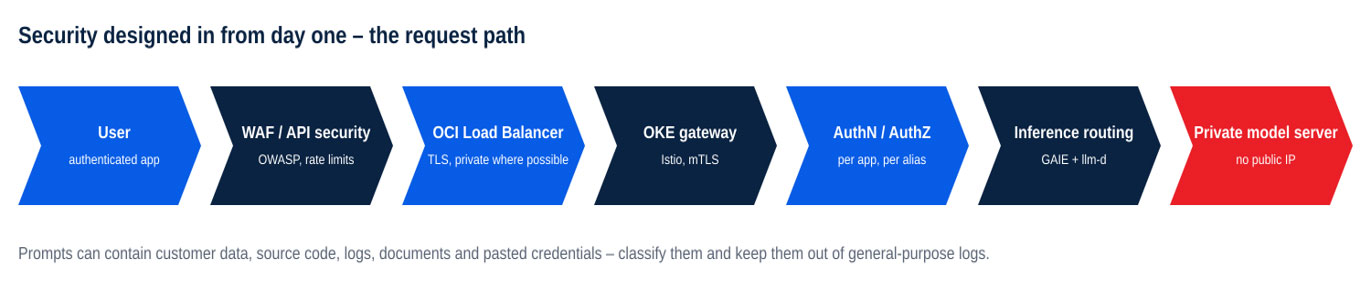
Check these as the pilot progresses:
- Resilience: At least two vLLM replicas per pool, pod disruption budgets, spread across fault domains
- Security: Private gateway, OCI WAF, authentication and rate limits; mTLS to model servers
- Data handling: Prompts and responses kept out of general logs; retention rules agreed with the customer
- Secrets: Model registry tokens and keys in OCI Vault, not in manifests
- Observability: TTFT, tokens/s, queue depth and GPU utilisation in OCI Monitoring and Grafana, with alarms
- Capacity: GPU node-pool autoscaling and a documented fallback when GPUs are exhausted
- Change control: Pinned versions of Gateway API, GAIE, llm-d and Istio, deployed through GitOps
- Cost: Per-alias cost tags so each tier’s cost per request can be reported
Our Recommendation and the 90-Day Pilot
Recommendation: Build a production-shaped version of this pattern on our own OCI tenancy, measure it, and turn it into a repeatable digi edZe offer for customers running GenAI on OCI.
| Phase | Weeks | Outcome | Exit criterion |
| 1. Reproduce | 1–3 | Oracle’s walkthrough rebuilt in our tenancy with pinned versions | Both aliases answer; HTTPRoute fully Programmed |
| 2. Harden and measure | 4–8 | Two replicas per pool, private gateway, WAF, dashboards; load tests | Baseline TTFT, tokens/s and cost per 1,000 requests per tier |
| 3. Prove “Enabled” features | 9–12 | Load-aware and cache-aware picking, a canary rollout, internal service-desk use case | Measured gain versus Phase 2; go/no-go pack for management |
Pilot KPIs
| KPI | Target |
| Time to first token (Fast tier, p95) | Set from the Phase 2 baseline |
| GPU utilisation during business hours | Higher than a single-pool GPU baseline |
| Cost per 1,000 requests (blended) | Lower than all-GPU serving for the same mix |
| Failed or rejected requests | Below 0.5% in load tests |
| Time to switch a model behind an alias | Minutes, with no application change |
Decisions We Need From Management
| Decision | Approve | Defer |
| Run the 90-day pilot as described | ☐ | ☐ |
| Budget for one A10 GPU node and supporting CPU pools for 12 weeks | ☐ | ☐ |
| Assign one platform engineer and one AI engineer (50% each) | ☐ | ☐ |
| Use an internal service-desk dataset (anonymised) for Phase 3 | ☐ | ☐ |
| Prepare a customer-facing “AI inference platform on OCI” offer if KPIs are met | ☐ | ☐ |
Final thoughts
Oracle’s walkthrough is small, but the direction is significant. The question platform teams ask is changing from “Which server is healthy?” to “Which inference endpoint is best suited for this request?” OKE now answers that with open standards, which matters for customers who need hybrid, sovereign or multi-cloud options.
For digi edZe this is a natural extension of what we already do: secure OCI landing zones, OKE and OpenShift platforms, observability and managed operations. Adding an inference-aware front door lets us offer customers a measurable, tiered GenAI platform rather than a single expensive GPU cluster.
Glossary
| Term | Meaning |
| OKE | Oracle Cloud Infrastructure Kubernetes Engine, Oracle’s managed Kubernetes service |
| Gateway API | The Kubernetes standard for describing how traffic enters a cluster |
| GAIE | Gateway API Inference Extension: adds InferencePool and the Endpoint Picker contract for model servers |
| InferencePool | A group of model-server pods that serve the same model on similar hardware |
| EPP | Endpoint Picker: chooses which pod in a pool gets each request (here provided by llm-d) |
| IPP | Inference Payload Processor: reads the model name from the request body and turns it into routing headers |
| InferenceModelRewrite | Maps a public alias such as support-fast to the model name the server actually serves |
| vLLM | Open-source, high-throughput LLM serving engine |
| KV cache | Memory of already-processed prompt tokens; reusing it saves GPU time |
| TTFT | Time to first token: how quickly an answer starts streaming |