

AlloyDB for PostgreSQL is Google Cloud’s fully managed, PostgreSQL-compatible database service built on Google’s cloud-native architecture. It delivers up to 4x faster transactional performance and 100x faster analytical queries compared to standard PostgreSQL, while maintaining full PostgreSQL compatibility. AlloyDB’s integrated AI capabilities — including pgvector for vector search, Vertex AI integration for embeddings, and the alloydb_ai_nl extension for natural language queries — make it the first database designed for both traditional applications and AI workloads.
Why AlloyDB performs
Four design choices sit behind the numbers in most business cases:
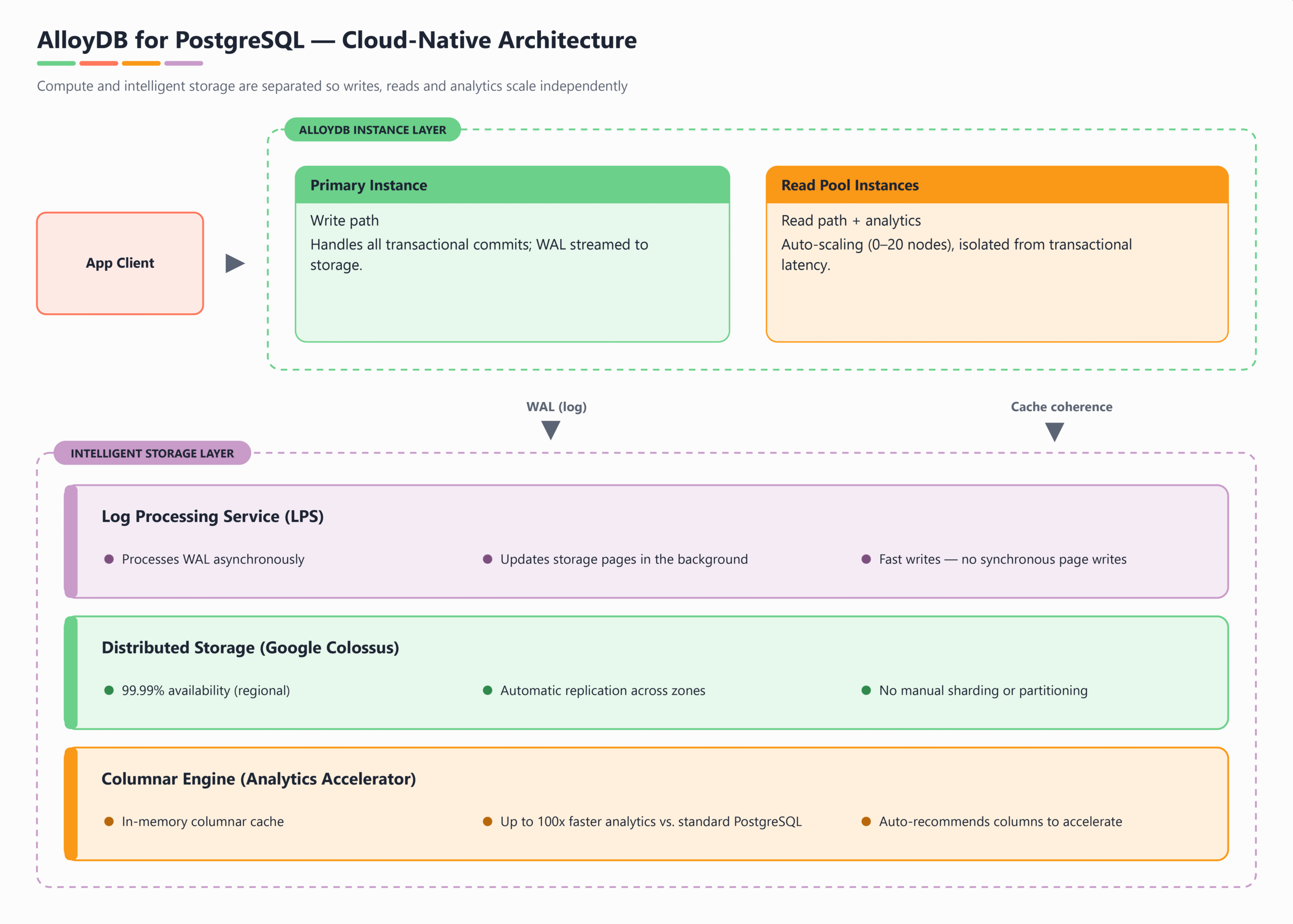
- Intelligent storage: A log processing service applies changes to storage pages in the background, so commits do not wait on page writes. Data is replicated across zones with no manual sharding.
- Read pool instances: Reads and analytics scale out independently of the primary, protecting transactional latency.
- Columnar engine: An in-memory columnar cache accelerates analytical queries and recommends which columns are worth caching.
- AlloyDB AI: pgvector-compatible vector search, the ScaNN index, Vertex AI model calls from SQL, and the alloydb_ai_nl extension for natural-language queries.
Where migrations go wrong
Databases rarely fail migration. Programs do, and the patterns repeat:
- No performance baseline, so success is argued rather than measured.
- Extension, version and dependency gaps discovered in the final weeks.
- A cutover that has never been rehearsed, and a rollback that exists only on a slide.
- Performance features are treated as an afterthought, so the business case is never realized.
- No named owner for cost, access and day-2 operations.
Architecture: AlloyDB Cloud-Native Design
AlloyDB AI: Integrated AI Capabilities
| Feature | Description | Use Case |
| pgvector | Vector similarity search in PostgreSQL | Semantic search, RAG, recommendations |
| Vertex AI Integration | Call Vertex AI models from SQL | Generate embeddings, predictions in-DB |
| alloydb_ai_nl | Natural language to SQL | Business user self-service queries |
| ScaNN Index | Google’s fast ANN index for vectors | 10x faster vector search vs. HNSW |
| ML Model Serving | Host custom models in-database | Real-time scoring without data movement |

GCP Migration, Powered by digi edZe with AlloyDB for PostgreSQL
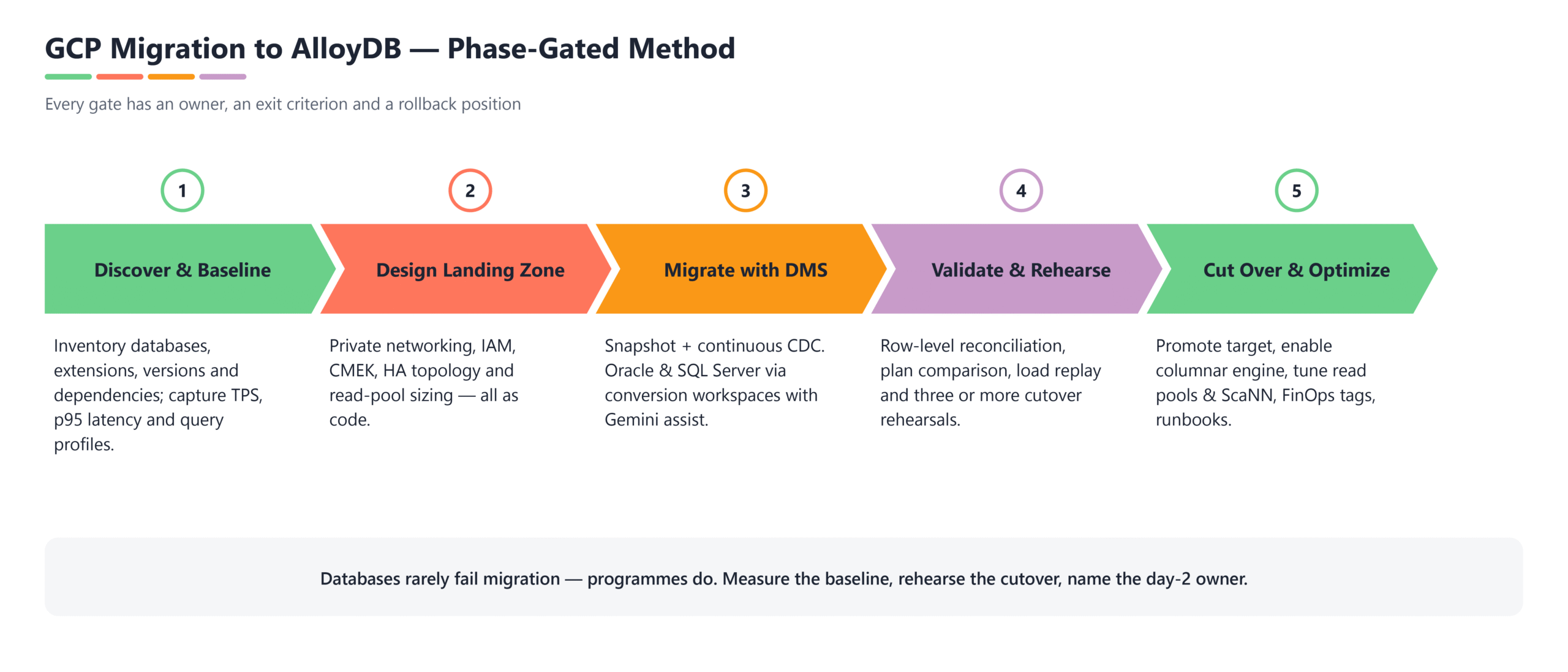
Our GCP database programmes follow a phase-gated method. Every gate has an owner, an exit criterion and a rollback position.
- Discover and baseline: Inventory every database, extension, version and upstream dependency. Capture transaction rates, p95 latency and query profiles, so the target state is judged against numbers.
- Design the landing zone: Private networking, IAM, customer-managed encryption keys, high-availability topology and read pool sizing, all defined as code so the foundation is repeatable and auditable.
- Migrate with Database Migration Service: An initial snapshot followed by continuous change data capture keeps source and target in step. PostgreSQL sources such as Cloud SQL, Amazon RDS, Aurora and self-managed estates move directly. Oracle and SQL Server estates move through conversion workspaces with Gemini-assisted schema conversion.
- Validate and rehearse: Row-level reconciliation, query plan comparison and production-shaped load replay, followed by at least three full cutover rehearsals and a tested way back.
- Cut over and optimize: Promote the target, enable the columnar engine on the right tables, tune read pools and ScaNN indexes, tag costs for FinOps, and hand over runbooks with a trained team.
Because digi edZe also delivers data engineering, AI and multicloud, what lands on AlloyDB is modernized.
High-Level Use Cases
Use Case 1: AI-Powered E-Commerce Search
An e-commerce platform migrates from Cloud SQL to AlloyDB. Product catalog is stored in AlloyDB with pgvector embeddings generated via Vertex AI integration. Semantic search queries (‘comfortable running shoes for flat feet’) use ScaNN index for sub-10ms similarity search across 10M products.
Key Benefits:
- 4x faster transactional performance for checkout/order flows
- Semantic search with pgvector — no separate vector database needed
- ScaNN index: 10x faster than HNSW for million-scale vectors
- Full PostgreSQL compatibility — no application code changes for migration
Use Case 2: Real-Time Analytics on Transactional Data
A fintech company runs AlloyDB with the Columnar Engine enabled. Transactional workloads (payments, transfers) run on the primary instance while analytical queries (daily summaries, fraud patterns, risk scoring) run on read pool instances with columnar acceleration — zero ETL, zero latency.
Key Benefits:
- 100x faster analytical queries with Columnar Engine
- Zero impact on transactional performance (read pool isolation)
- No ETL pipeline — analytics on live data
- Auto-scaling read pool handles variable analytical workloads
Use Case 3: Oracle Modernization for BFSI
An insurer retires from a license-heavy Oracle estate. Schemas are converted in phases through a conversion workspace, Gemini helps explain and fix PL/SQL conversion issues, and continuous replication keeps the new platform in step until a rehearsed cutover.
Key benefits:
- A move from proprietary licensing to a PostgreSQL-compatible engine.
- Phased conversion limits risk and lets business units migrate in waves.
- Continuous replication keeps the final cutover window short.
- The estate gains vector search and in-database AI that the legacy platform could not offer.
Use Case 4: Regulated and Edge Deployments with AlloyDB Omni
A healthcare group must keep certain patient data on its own premises. AlloyDB Omni, the downloadable edition of AlloyDB, runs the same engine in its own environment, while other workloads run on managed AlloyDB in Google Cloud.
Key benefits:
- One engine and one skill set across cloud, data centre and edge.
- Residency obligations met without introducing a second database technology.
- A clear path to managed AlloyDB when regulation and strategy allow.
Best Practices & Recommendations
- Enable Columnar Engine for tables frequently used in analytical queries
- Use Read Pool instances for analytical workloads to isolate from transactional traffic
- Leverage ScaNN index instead of HNSW for large-scale vector similarity search
- Use Vertex AI integration to generate embeddings in-database — avoid data export
- Enable AlloyDB AI for natural language query access for business users
- Use AlloyDB Omni for on-premises/edge deployments with the same AlloyDB engine
Conclusion
AlloyDB gives enterprises a credible way to consolidate transactional, analytical and AI workloads on PostgreSQL without trading away compatibility. But the benefit is realized by the programme, not the product. A measured baseline, a rehearsed cutover and a clear day-2 owner turn a promising database into a dependable platform. digi edZe brings the architects, the phased method and the cross-cloud experience to make that happen.