

Migrating a production database across cloud providers without downtime is the Everest of database engineering. When your systems process millions of transactions daily and your SLA mandates 99.99% availability, the margin for error is zero. Yet in 2026, cross-cloud database migration is no longer optional — it is a strategic imperative driven by cost optimization, regulatory compliance, vendor diversification, and acquisition-driven multi-cloud consolidation.
This blog provides a comprehensive, battle-tested framework for executing zero-downtime cross-cloud database migrations, covering architecture patterns, replication topologies, cutover strategies, and the often-overlooked operational procedures that separate successful migrations from career-defining incidents.
Why Zero-Downtime Migration Matters
Cost of Downtime by Industry (2026)
| Industry | Cost per Minute of Downtime |
| Financial Services | $9,000 – $12,000 |
| e-Commerce | $5,600 – $8,500 |
| Healthcare | $4,200 – $6,800 |
| Manufacturing | $3,500 – $5,200 |
| Media/Streaming | $2,800 – $4,500 |
| SaaS/Technology | $2,200 – $3,800 |
- SLA breach penalties — contractual obligations with enterprise customers
- Regulatory scrutiny — financial regulators view unplanned outages as operational risk events
- Customer churn — 32% of customers switch providers after a single significant outage
- Reputational damage — social media amplifies incidents within minutes
Prerequisites and Readiness Assessment
Zero-Downtime Readiness Checklist
Network | · Private Connectivity (VPN/Direct Connect)/ExpressRoute/Interconnect) |
Data | · Schema compatibility |
Application | · Connection retry logic |
Operations | · Monitoring on both clouds |
Compliance | · Data Residency requirements |
Team | · Migration rehearsal completed |
Architecture Patterns for Zero-Downtime Migration
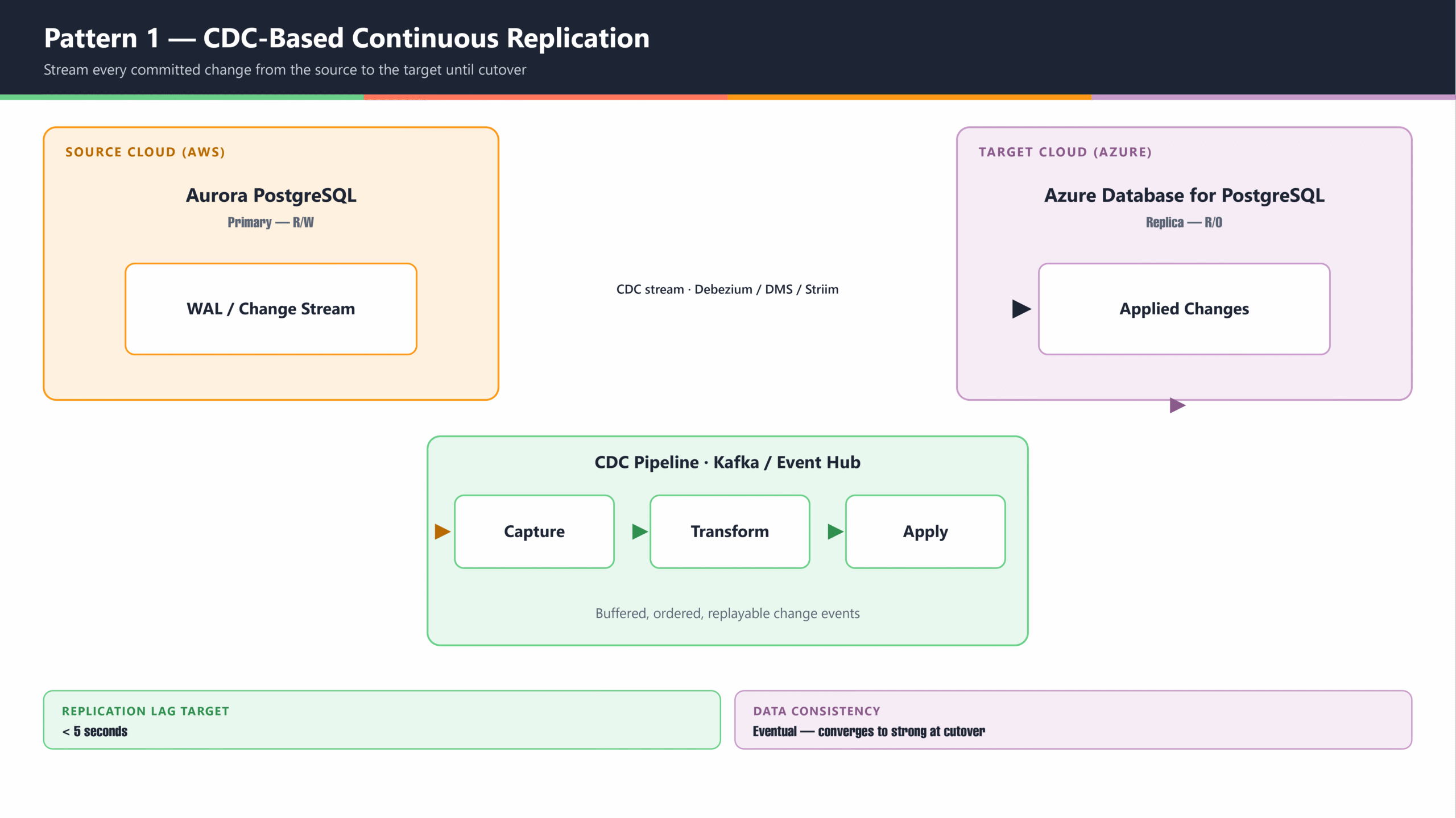
Pattern 1: Continuous Data Replication (CDC-Based)
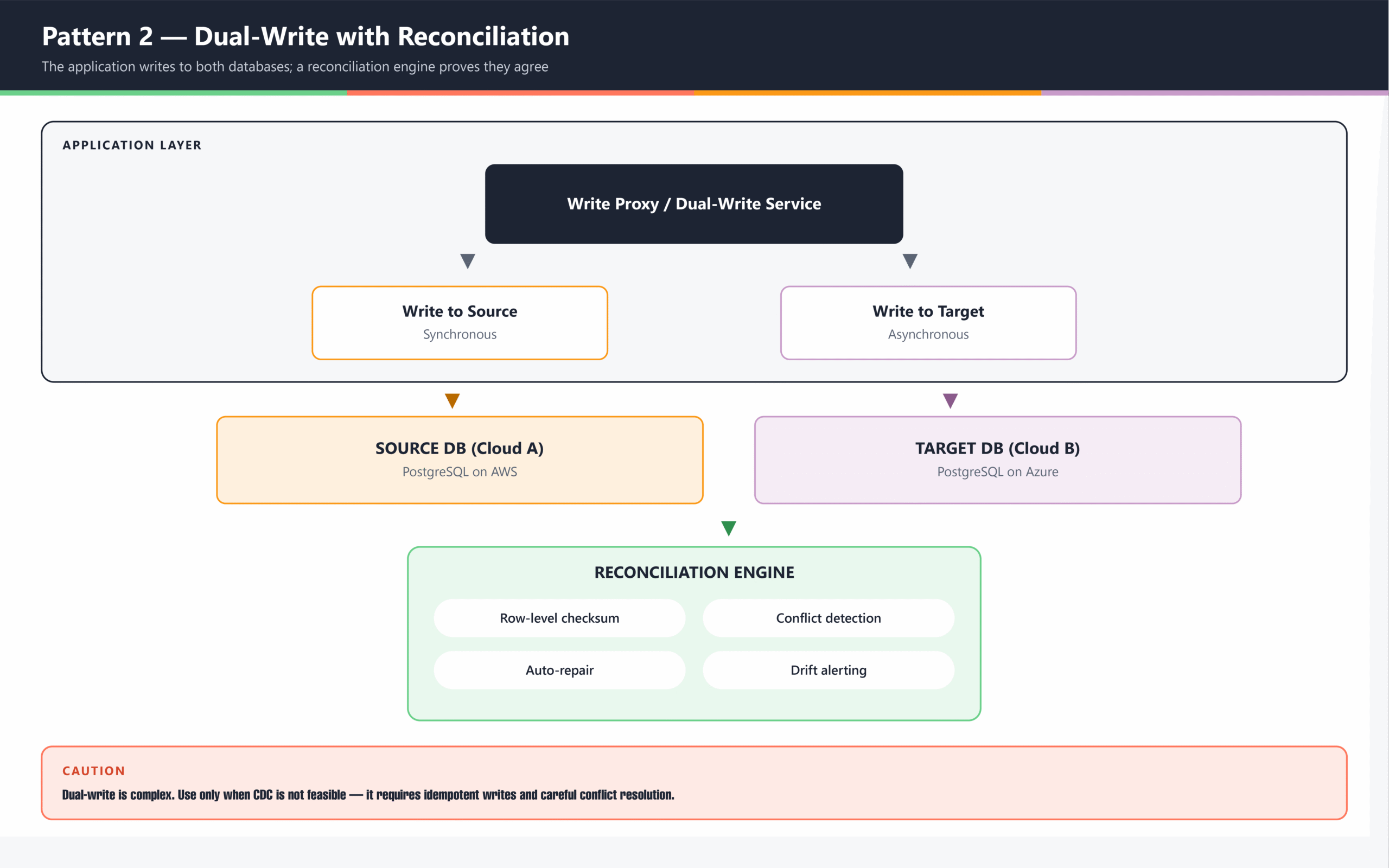
Pattern 2: Dual-Write with Reconciliation
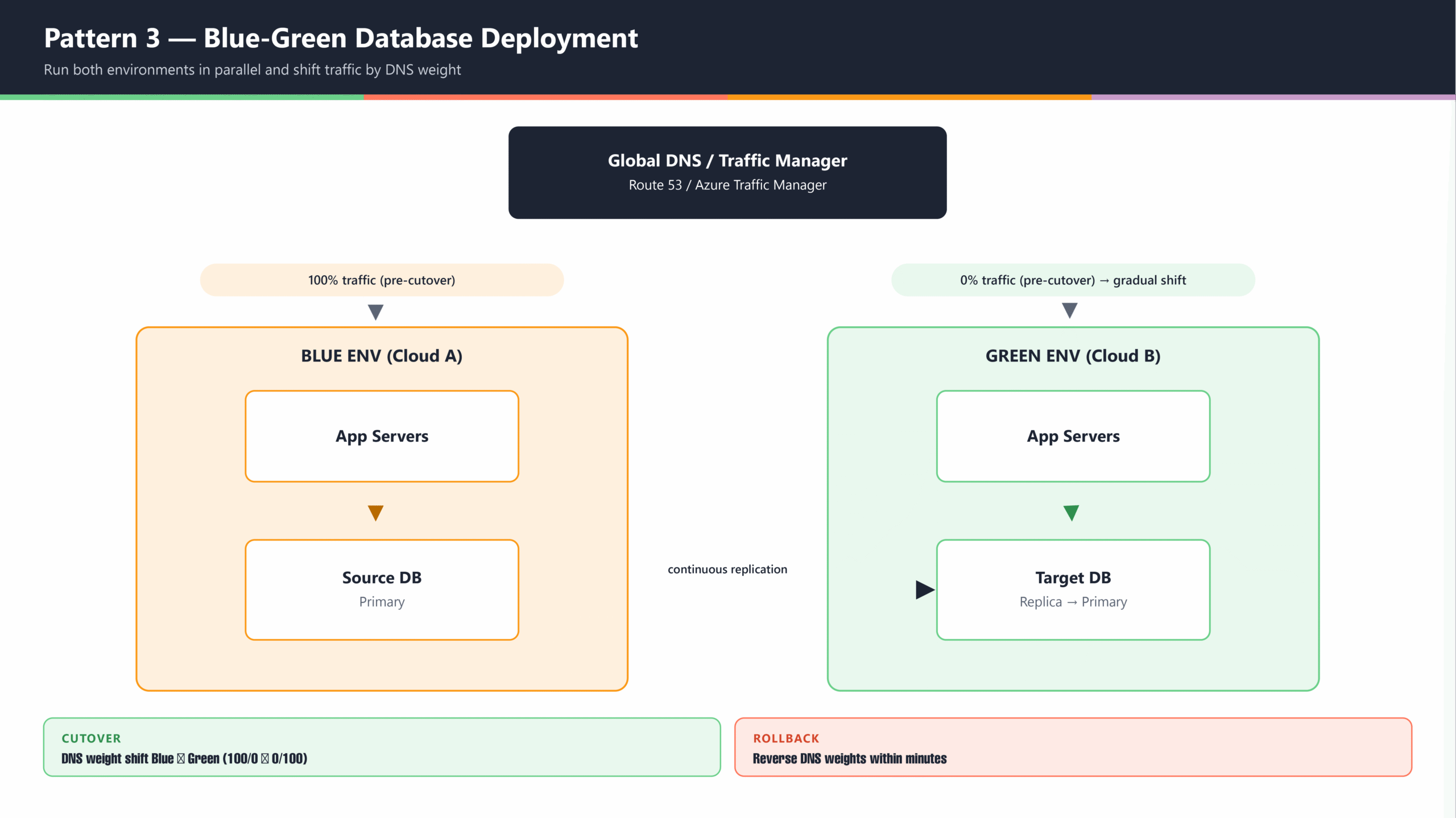
Pattern 3: Blue-Green Database Deployment
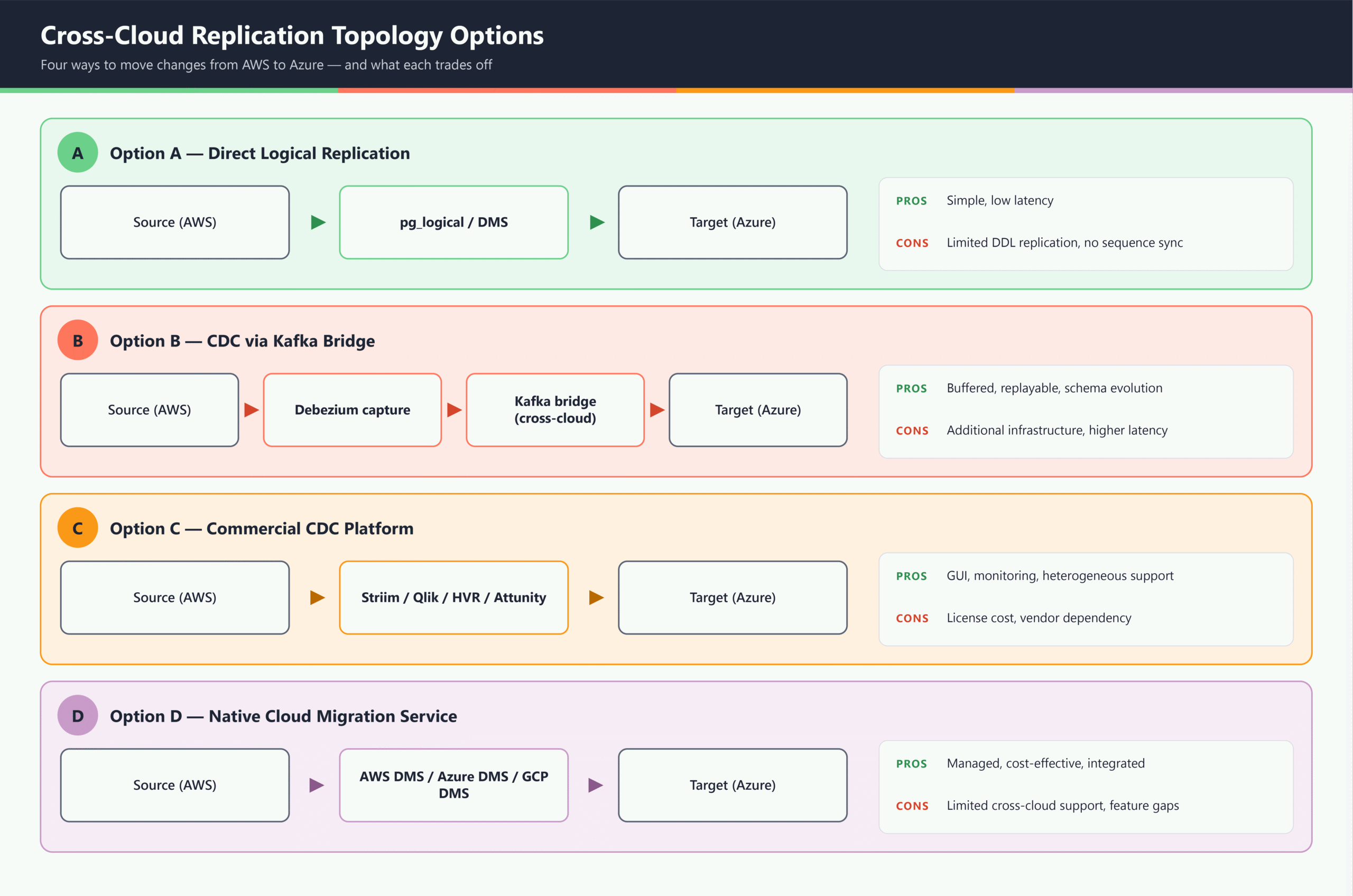
Replication Topologies
Cross-Cloud Replication Architecture
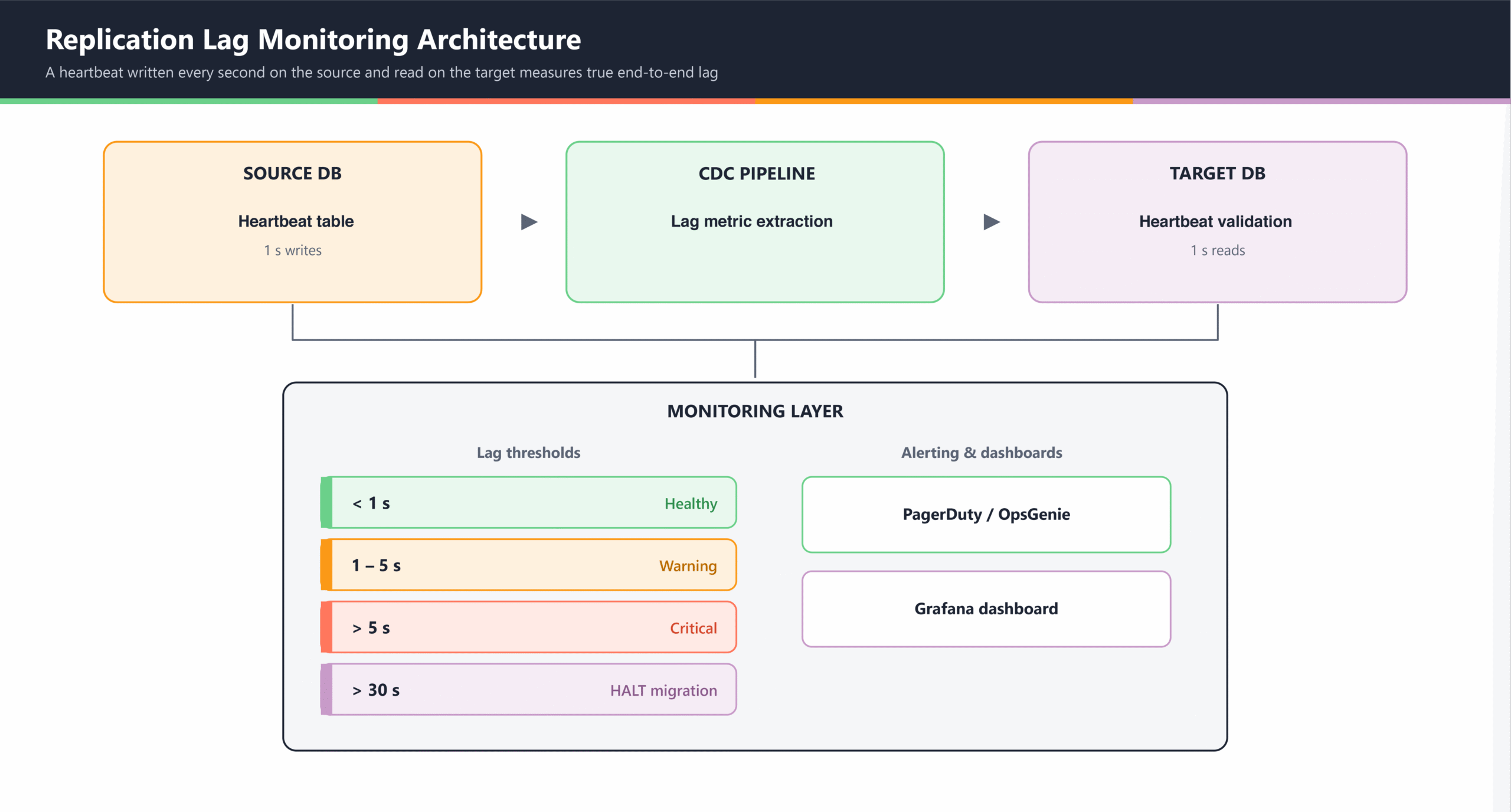
Replication Lag Monitoring Architecture
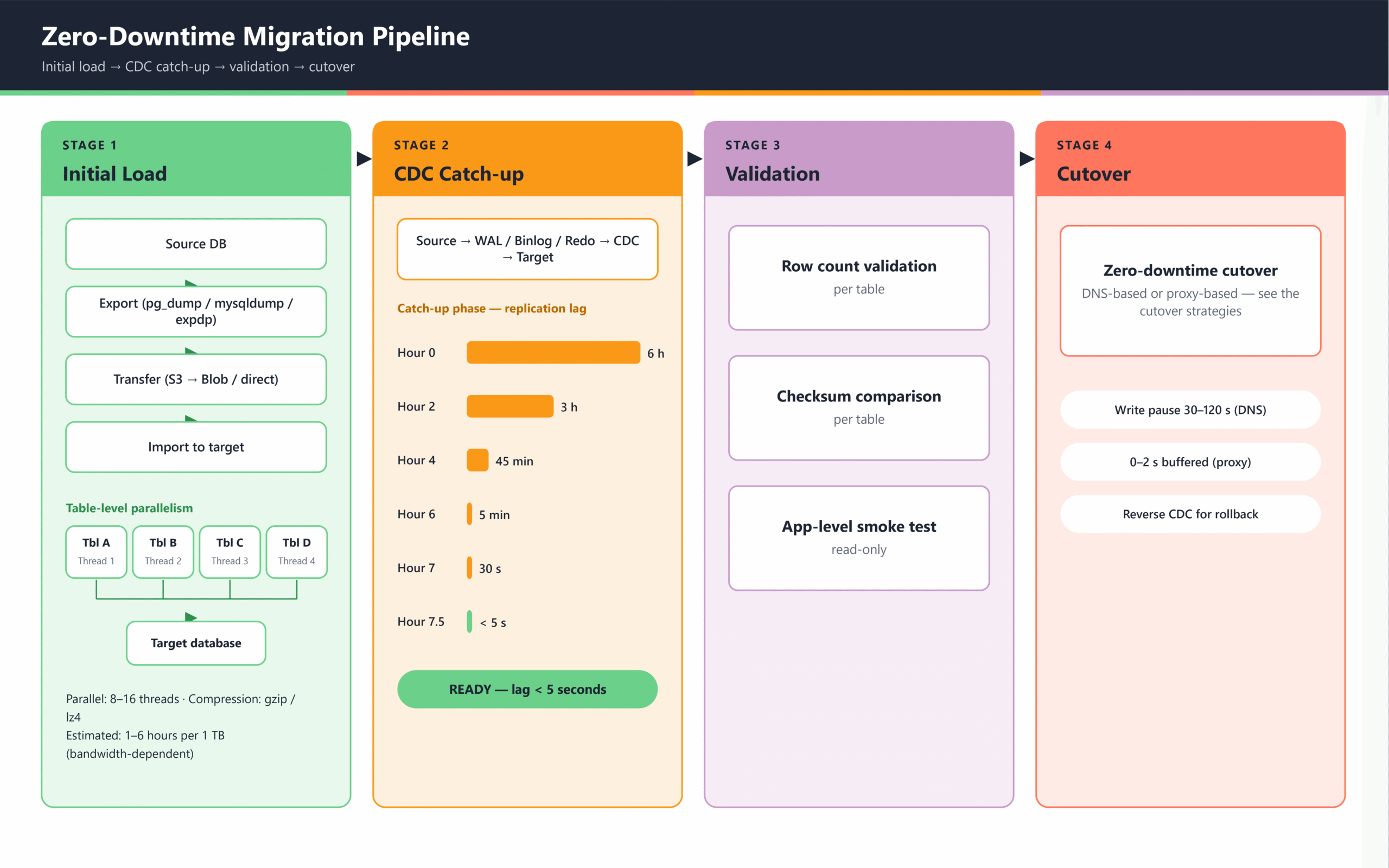
The Migration Pipeline
End-to-End Migration Pipeline
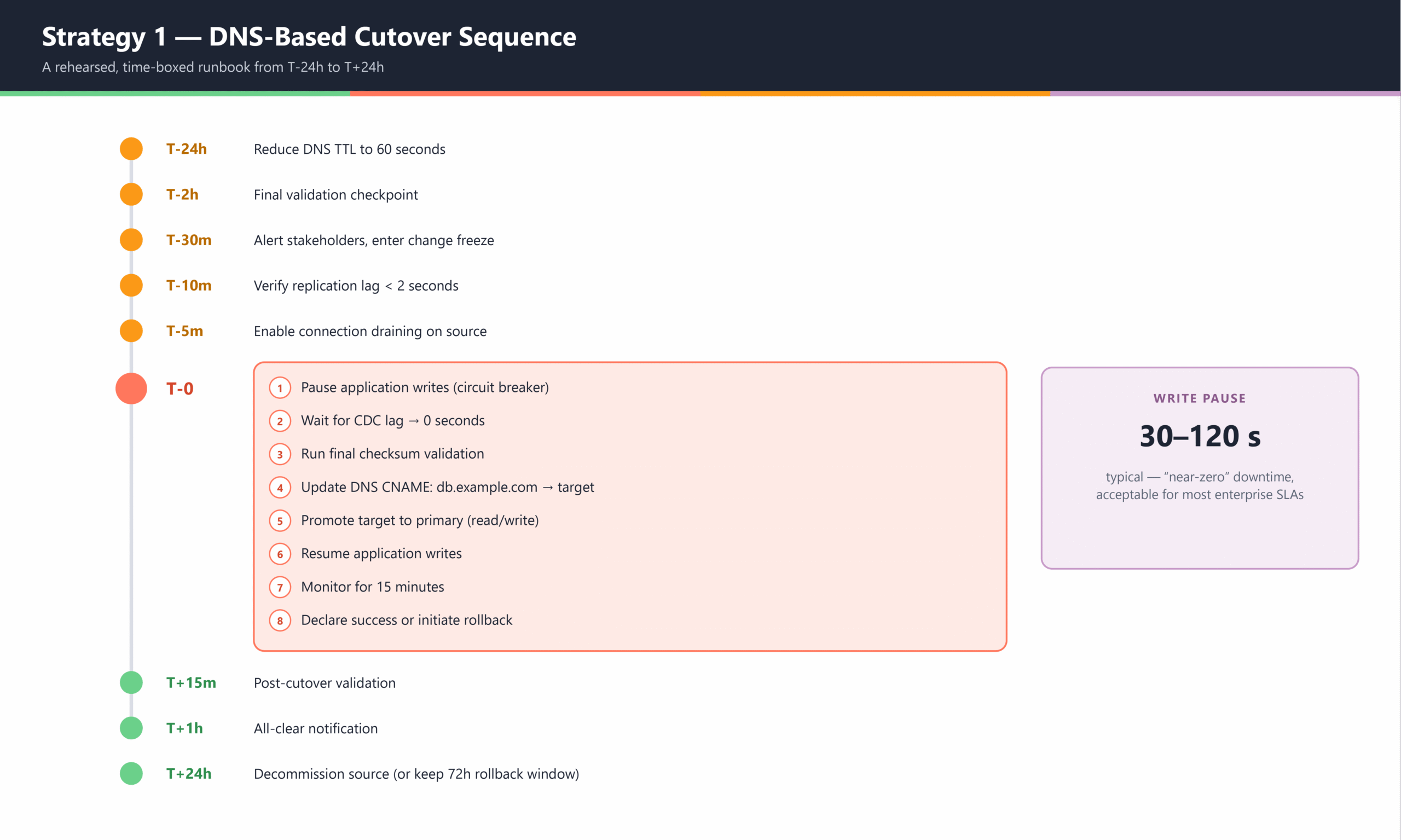
Cutover Strategies
Strategy 1: DNS-Based Cutover
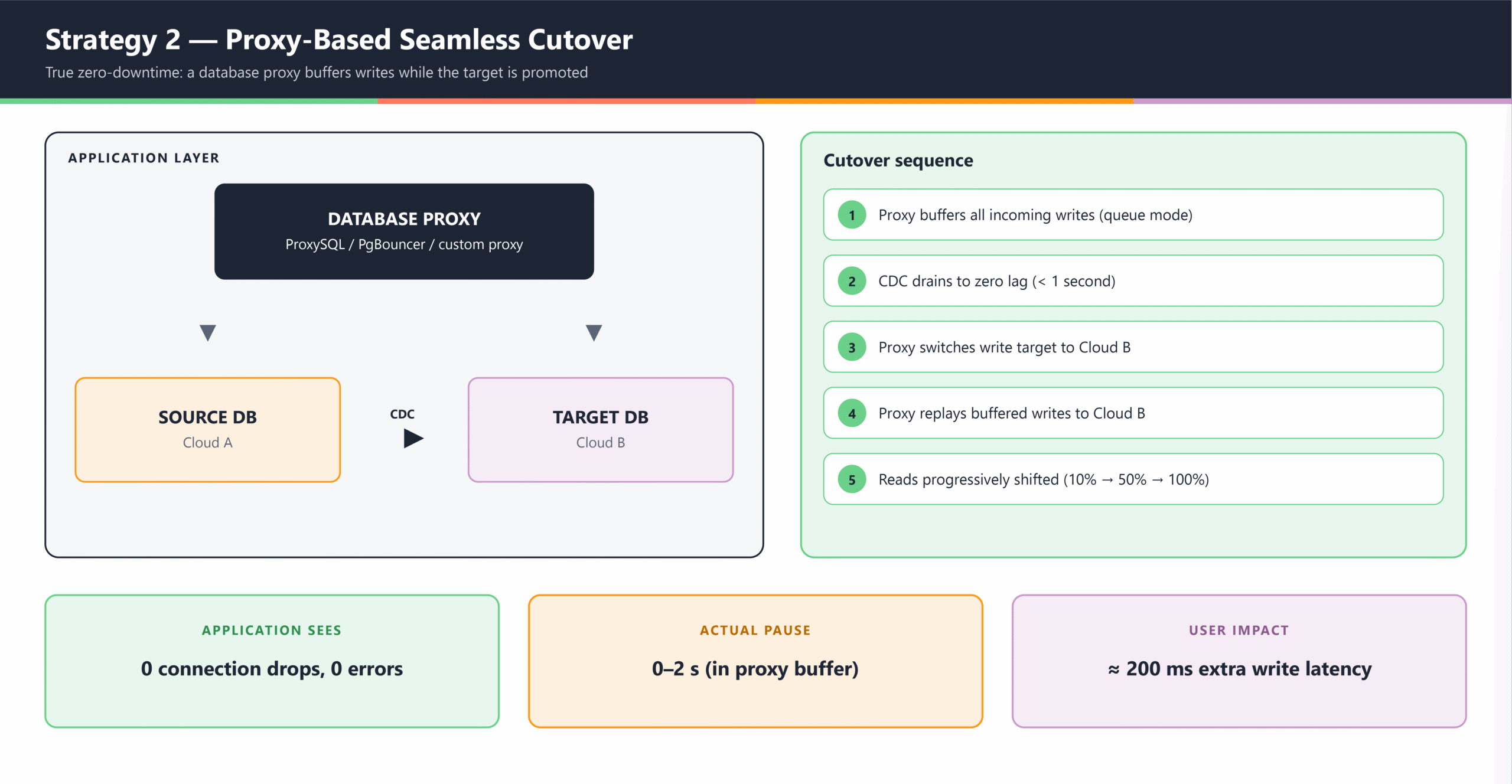
Strategy 2: Proxy-Based Seamless Cutover (True Zero-Downtime)
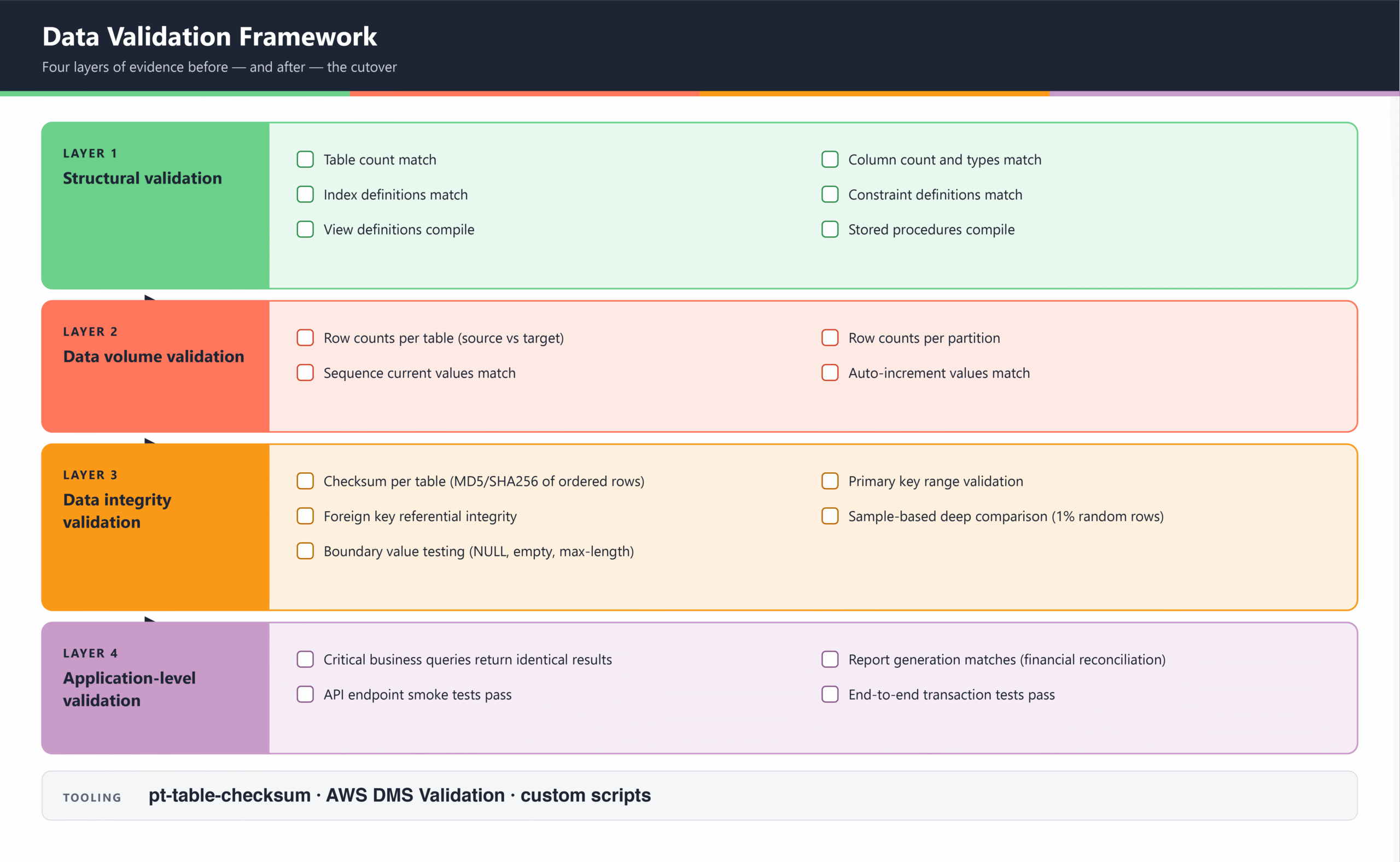
Data Validation Framework
Multi-Layer Validation Architecture
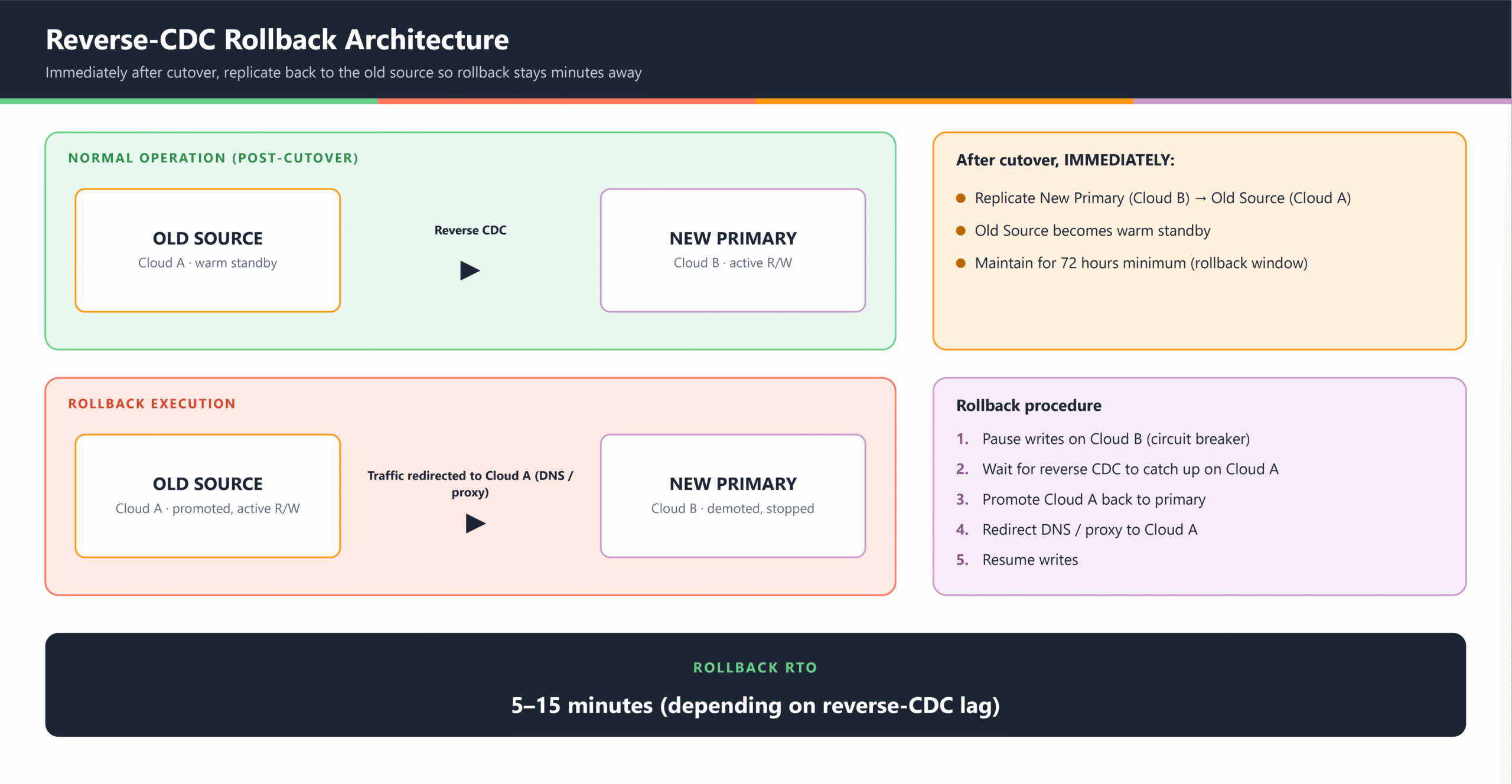
Rollback Architecture
Reverse-CDC Rollback Pattern
Challenges and Solutions
| Challenge | Impact | Solution |
| Cross-cloud network latency | CDC replication lag spikes | Dedicated interconnect (AWS Direct Connect ↔ Azure ExpressRoute via Megaport); compress CDC payloads |
| Schema drift during migration | DDL changes on source break CDC | Implement DDL freeze window; use schema evolution-capable CDC (Debezium with Avro schema registry) |
| Large object (LOB) replication | BLOBs/CLOBs slow down CDC pipeline | Externalize LOBs to object storage (S3/Blob); replicate metadata only |
| Sequence/Identity conflicts | Duplicate key errors post-cutover | Reserve sequence ranges; offset identity seeds; use UUID where possible |
| Timezone discrepancies | Timestamp data appears incorrect | Normalize all timestamps to UTC before migration; validate timezone settings on target |
| Stored procedure compatibility | Procedural code fails on target engine | Automated conversion tools (AWS SCT, Ora2Pg); manual review of edge cases |
| Certificate/TLS mismatch | Connection failures during cutover | Pre-provision TLS certificates on target; update trust stores in advance |
| Collation differences | Sort order changes break application logic | Explicitly set collation on target to match source; test ORDER BY queries |
Real-World Use Cases
Use Case 1: FinTech — AWS Aurora to Azure SQL
- Context: A payments processing company needed to migrate from AWS to Azure after an acquisition by an Azure-native parent company. Processing 15,000 transactions/second with a contractual 99.99% SLA.
- Approach: – CDC-based continuous replication using Striim – Proxy-based cutover using custom ProxySQL configuration – 6-week migration timeline with 3 rehearsals
- Outcomes
- Zero transaction loss
- Zero customer-visible downtime
- 3 seconds of write buffering during cutover
- Rollback capability maintained for 5 days post-cutover
Use Case 2: SaaS Platform — GCP Cloud SQL to AWS Aurora
- Context: A B2B SaaS platform migrating 2,000 tenant databases from GCP to AWS for cost optimization and proximity to key customers.
- Approach: – Tenant-by-tenant migration using Blue-Green pattern – Feature flag-driven traffic routing per tenant – 4-month rolling migration (50 tenants/week)
- Outcomes
- Each tenant migration: < 5 seconds of read-only mode
- Zero data loss across all 2,000 migrations
- 35% reduction in database costs post-migration
Conclusion
Zero-downtime cross-cloud database migration is achievable but demands meticulous planning, robust tooling, and disciplined execution. The key principles are:
- Invest in CDC infrastructure: It is the backbone of zero-downtime migration.
- Rehearse: Every production cutover should be preceded by at least 3 full rehearsals.
- Always have a rollback plan: Reverse CDC is not optional; it’s insurance.
- Validate obsessively: Multi-layer data validation catches what unit tests cannot.
- Communicate proactively: Stakeholders should never be surprised by migration activities.
Modern migration technologies make near-zero downtime database migration achievable across cloud platforms. Success, however, depends less on the tooling itself and more on disciplined planning, repeated rehearsals, comprehensive validation, and well-defined rollback procedures.