Modern applications must have the capabilities that will shape its performance, security, and scalability, promising long-term support and continuity. In today’s world, proprietary platforms, managed services, and specialized engines became go-to options for many enterprises yet PostgreSQL has emerged as one of the most compelling options for business leaders.
Postgres is an open-source relational database that became a trusted backbone for enterprises, ranging from early startups to large-scale organizations. It brings the capabilities such as enterprise-grade reliability without licensing costs, richly extensible architecture that adapts to virtually any workload, and a vibrant global continuity that makes the platform evolve. It can also power complex transactional systems, analytical workloads, and hybrid data models simultaneously, combining the supreme state of maturity and innovation. It’s trusted by developers and enterprises worldwide for its flexibility, reliability, and cutting-edge features.
Why PostgreSQL Stands Out in the Enterprise Landscape?
Open Source and Cost-Effective
PostgreSQL is entirely free and open source, governed by the permissive PostgreSQL License that imposes no restrictions on usage, modification, or distribution. This eliminates the significant licensing costs associated with proprietary databases while delivering capabilities that rival or exceed commercial alternatives. For enterprises managing hundreds of database instances across multiple environments, the cost savings alone can be the massive advantage.
Advanced Features
PostgreSQL goes beyond traditional relational databases by offering:
- ACID compliance for reliable transactions
- Complex queries and indexing
- Full-text search
- Support for JSON, XML, and custom data types
- Extensible architecture for custom functions, operators and data types
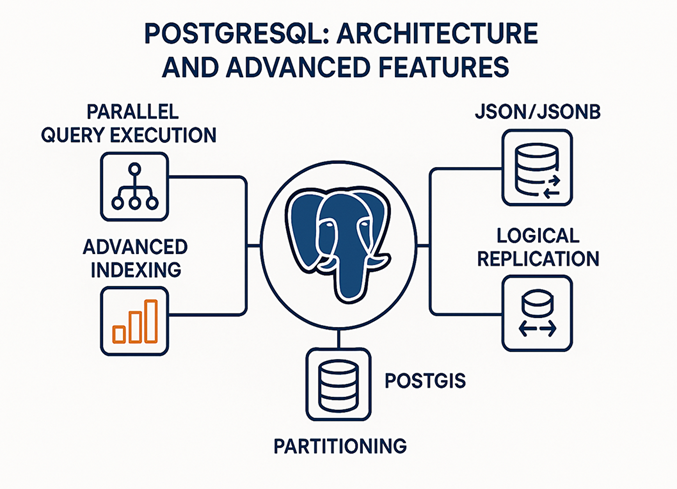
Advanced PostgreSQL Features Powering Modern Workloads
- JSON/JSONB Support: PostgreSQL’s native support for JSON and JSONB (binary JSON) enables developers to store and query semi-structured data with the same efficiency as structured relational data. This capability is particularly valuable for hybrid workloads that blend traditional relational schemas with the flexibility of document-oriented data models, eliminating the need for a separate NoSQL database in many architectures.
- Partitioning and Parallel Query Execution: Modern PostgreSQL versions introduce declarative table partitioning, which simplifies the management of large tables by splitting them into smaller, more manageable segments without requiring complex triggers or custom logic. Combined with parallel query execution, these features deliver substantial performance improvements for large-scale analytical workloads and time-series data processing.
- Logical Replication: It supports logical replication, enabling selective data replication between databases at the table level. This capability is essential for high-availability architectures, zero-downtime migration scenarios, and distributed systems where different database instances need to maintain synchronized subsets of data.
- Advanced Indexing: Provides a rich set of indexing options including GIN, GiST, BRIN, and hash indexes, each optimized for different query patterns and data types. This diversity allows database administrators to fine-tune performance for full-text search, geospatial queries, range queries, and high-cardinality lookups with precision that few other databases can match.
- PostGIS for Geospatial Data: This extension transforms PostgreSQL into a fully capable spatial database, supporting geographic objects, spatial indexing, and advanced geospatial analysis. For applications involving mapping, location-based services, logistics optimization, and GIS analytics, PostGIS delivers capabilities that are on par with dedicated geospatial platforms.
- Declarative Table Partitioning: Simplifies managing large tables by splitting them into smaller, more manageable partitions without complex triggers.
- Cloud and Container Integration: PostgreSQL integrates seamlessly with cloud platforms (AWS, Azure, Google Cloud) and container orchestration systems like Kubernetes, making it a top choice for modern DevOps workflows.
Why do Enterprises Choose PostgreSQL?
- Enterprise-grade security through SSL encryption, row-level security, and granular role-based access controls
- Offers scalability from single-instance deployments to distributed, multi-terabyte architectures
- Active global community and ecosystem of thousands of extensions ensure that new capabilities and integrations are continuously available
- Reduced operational complexity with its ability to handle both structured relational data and semi-structured JSOn data within a single engine
When Should You Use PostgreSQL?
- Applications requiring complex queries and analytics
- Systems handling structured and semi-structured data
- Projects needing high reliability and security
- Businesses looking for cost-effective, scalable solutions
PostgreSQL deployment & Migration options in a Multi-Cloud Environment
| Feature | AWS PostgreSQL (Amazon RDS / Aurora) | OCI PostgreSQL |
|---|---|---|
| Managed Service Type | Fully managed PaaS via Amazon RDS and Aurora PostgreSQL-Compatible Edition | Fully managed OCI PostgreSQL service |
| PostgreSQL Compatibility | Native PostgreSQL with Aurora-optimized enhancements | Native PostgreSQL with standard extensions and tools |
| High Availability | Multi-AZ deployments with automatic failover | Built-in replication and automatic failover |
| Scalability | Vertical scaling, read replicas, Aurora distributed storage | Flexible compute and storage scaling |