Data needs protection and it isn’t a tough nut to crack but at the deeper levels. Unauthorized access can lead to major attacks, disrupting the business continuity. This is where we can enable Database Ledger, an SQL Server introduced in 2022 that enhances data security and safeguards data against attackers and high-privileged users such as DBA’s, system administrators, and cloud administrators.
SQL Server Ledger, introduced in SQL Server 2022 adds tamper-evident capabilities to databases by using cryptographic hashes to prevent undetected data changes while maintaining historical data in a relational format for SQL-based auditing and analysis.
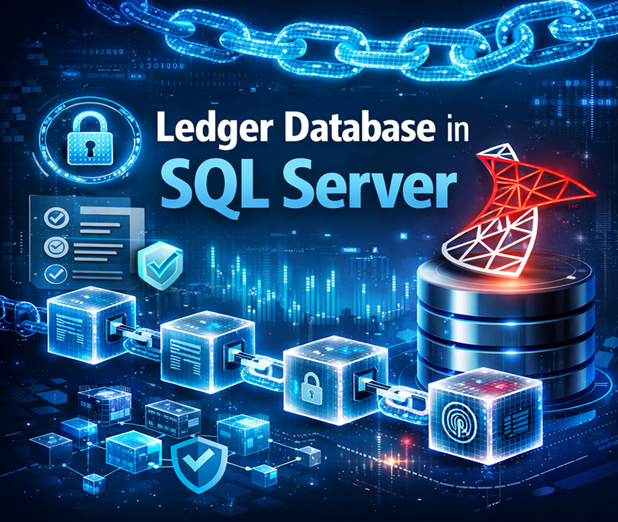
The Database Ledger works like a traditional ledger, recording historical data. When a row is updated, SQL Server stores its previous value in a history table. This feature uses blockchain technology to ensure cryptographic data integrity. SQL Server hashes each transaction with SHA-256, generates a root hash and then links it to the previous block’s hash – forming a secure chain of records.
SQL Server Ledger is a Game-Changer for Data Trust
In the world where data integrity challenges the trajectory of the entire organization, the ability to verify that records have not been tampered becomes a strategic imperative. SQL Server Ledger transforms ordinary database tables into tamper-evident, cryptographically secured records, giving enterprises the power to prove the authenticity of their data at any point in time.
This capability addresses the most persistent blind spots in enterprise data management – insider threat. Traditional security models assume that privileged users are trusted. The Ledger removes this assumption entirely and ensures that even database administrators and cloud operators cannot alter historical records without leaving a detectable trace.
Key Features and Capabilities
Tamper Detection
The Ledger leverages SHA-256 cryptographic hashing, structured through a Merkle tree architecture and anchored in a blockchain-style chain. Every transaction is hashed individually, and these hashes are aggregated into a root hash for each block. If any record is altered, the cryptographic chain breaks and the verification process immediately surfaces the unauthorized change.
Data Integrity Protection
By maintaining an immutable, append-only log of every modification, the Ledger safeguards data against manipulation regardless of the source. Whether the threat originates from an external attacker who has escalated privileges or an insider with legitimate administrative access, the historical record remains intact and verifiable.
Auditability and Regulatory Compliance
For organizations subject to regulatory frameworks such as SOX, HIPAA, or GDPR, the Ledger provides a significant advantage. It generates verifiable, cryptographic evidence of data integrity that auditors can independently validate. This substantially reduces the time, effort, and cost associated with compliance audits, while strengthening the organization’s overall compliance posture. Rather than relying on procedural controls and self-attestation, companies can offer mathematical proof that their data has remained untampered.
Built-in Transparency
One of the most elegant aspects of the SQL Server Ledger is that historical data tracking operates entirely behind the scenes. Applications that read from and write to ledger-enabled tables require no modifications. The cryptographic hashing, history table management, and chain verification all happen at the database engine level, delivering full transparency and traceability without application-layer overhead.
Zero Application Overhaul
Perhaps most importantly, enabling Ledger functionality does not require a redesign of existing applications. It layers onto existing database schemas seamlessly with minimal configuration changes, dramatically lowering the barrier to adoption and allowing organizations to benefit from tamper-evident protection without costly re-engineering.
Types of Ledger Tables
SQL Server Ledger provides two distinct table types, each designed for different operational patterns.
Updatable Ledger Tables
These are designed for data that evolves over time.
- Track all INSERT, UPDATE, and DELETE operations
- Records every change in a hidden history table accessible through standard SQL queries
- Tamper-proof audit trail must be maintained when records are modified frequently
- Best suited for financial systems, healthcare records, and regulatory reporting workloads
Append-Only Ledger Tables
Append-only ledger tables are for only event-based data.
- Allow only INSERT operations – where data can never be modified or deleted
- Purpose-built for event-driven architectures where the integrity of each record must be permanently guaranteed
- Audit logs, transaction receipts, supply chain events, and compliance records all benefit from the immutability that append-only tables enforce.
- Data remains permanently intact.
Strategic Capability for Every Layer of the Enterprise
When organizations function on the evolving complex threat landscape, verifying the integrity of critical data is a crucial and differentiating aspect, turning it into a strategic capability. It strengthens trust across the enterprise right from internal operations and financial reporting to customer-focused services and regulatory interactions.
Data security posture evaluation needs a quick turnover and it can happen with SQL Server Ledger. Enable it on your existing infrastructure with no application overhaul and build a mathematically verifiable chain of trust around your most critical data.