

Enterprise data architecture has the layer complexity that’s been accumulating for years. Also, today’s digital-first world enables the enterprises to operate across continents, serving millions of users simultaneously. Applications like e-commerce platforms, financial services, and social networks demand real-time responsiveness, high availability, and fault tolerance—no matter where their users are located.
Traditional monolithic databases struggle under this pressure:
- Performance bottlenecksoccur when millions of transactions hit a single database instance.
- Limited scalabilitymakes it difficult to expand capacity quickly.
- Fault propagationmeans that a single failure can ripple across the system, impacting global users.
- Complex replicationacross geographies often requires manual reconfiguration, slowing down innovation.
Due to these challenges, businesses face downtime, latency, and customer dissatisfaction.
This is where Oracle Globally Distributed Database steps in.
Hyperscale Computing with Sharding
Oracle database cloud portfolio remains uncompromised for businesses with different cost models, operational profiles, and strategic trajectories. Choosing one of them requires a deep dive assessment based on your workloads. The three platforms that Oracle offers are Database Cloud Service (DBCS), Exadata Cloud Service (ExaCS), and newest evolution – Exadata Database service on Exascale Infrastructure. Each has its own advantages on the spectrum of cost efficiency, scalability, and enterprise resilience.
Oracle Database Cloud Service (DBCS)
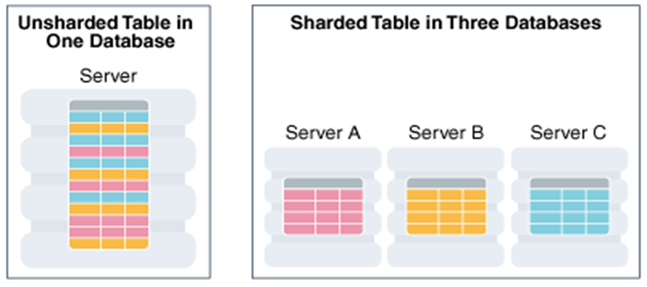
Oracle 26ai introduces hyperscale computing powered by sharding—a breakthrough architecture that partitions large datasets across multiple independent servers (shards).
Key Concepts:
- Shards: Independent databases, each holding a portion of the data.
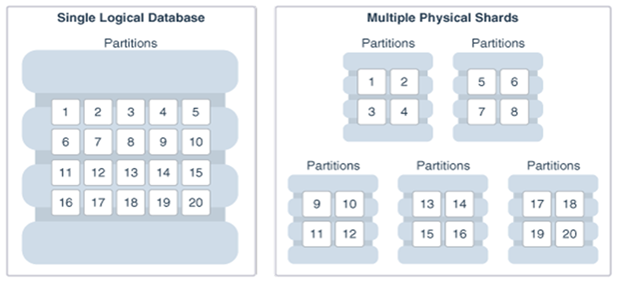
- Sharded Database: All shards together form one logical database, appearing unified to applications.
- Isolation: Each shard runs on separate hardware/software, ensuring failures don’t cascade.
- Distributed Partitioning: Tables are automatically partitioned across shards using the CREATE SHARDED TABLEcommand.
From the application perspective, it’s still one database.
From the DBA perspective, it’s a collection of databases managed collectively.
How Sharding Improves Global Distributed Transactions
Sharding directly addresses the pain points of global-scale systems:
1. Linear Scalability
- Oracle 26ai supports up to 1000 shards, enabling near-infinite horizontal scaling.
- As demand grows, new shards can be added seamlessly without reconfiguring replication.
- Transactions are distributed across shards, reducing contention and improving throughput.
2. Extreme Availability & Fault Isolation
- Each shard runs independently with its own CPU, memory, and storage.
- If one shard fails (planned or unplanned), only the users connected to that shard are affected.
- Other shards continue to operate normally, ensuring uninterrupted service globally.
3. Global Data Distribution
- Data can be partitioned geographically, placing shards closer to users.
- This reduces latency for global transactions, ensuring faster response times.
- Applications benefit from localized performancewhile still maintaining a unified global view.
4. Simplified Replication with Raft
- Unlike Data Guard, Raft replicationautomatically adapts when shards are added or removed.
- No manual reconfiguration is needed, reducing operational overhead.
- Replicas are self-managed, ensuring resilience and consistency across the distributed system.
Business Impact
By leveraging Oracle’s globally distributed sharded database:
- Enterprises achieve hyperscale performancefor millions of concurrent transactions.
- Systems remain highly available, even during failures.
- Global users experience low-latency access, no matter where they are.
- IT teams enjoy simplified managementwith automated replication and partitioning.
In short, sharding transforms the database from a bottleneck into a scalable, resilient backbone for modern global applications.
Conclusion
The future of data management lies in globally distributed architectures. Oracle’s sharded database in 26ai is not just a technical innovation—it’s a strategic enabler for businesses that demand speed, scale, and reliability across the globe.
By solving the challenges of global distributed transactions, Oracle empowers organizations to deliver seamless digital experiences—anytime, anywhere.