
The massive challenge for organizations is to maintain high availability and uptime as the minute downtime translates directly into revenue loss, customer dissatisfaction, and business disruptions. As a Database Administrator, the great responsibility is Database Recovery. DBAs backup databases with precision and confidence but the recovery process has remained unpredictable.
Traditional SQL Server recovery follows the ARIES (Algorithm for Recovery and Isolation Exploiting Semantics) protocol—a robust but time-consuming approach that processes the transaction log sequentially. During recovery, the database remains offline while SQL Server painstakingly walks through three phases: analysis, redo, and undo.
Microsoft’s introduction of Accelerated Database Recovery (ADR) reimagines how database recovery should function in modern, high-availability environments. With the traditional trade-off between transaction complexity and recovery time becoming unsupportive, ADR eliminates them entirely through an elegant architectural innovation.
Thus the improved stability and maturity for the feature Accelerated Database Recovery (ADR) is a key advantage for HA/DR environments valuable for large OLTP databases, Always On Availability Groups and strict RTO-driven HA/DR systems.
- Killing a long-running transaction
- Abnormal shutdown
In both cases, downtime is unpredictable and directly impacts business users.
Architecture of Accelerated Database Recovery
Once ADR is enabled on a database, SQL Server fundamentally changes how it manages transactional consistency and recovery:
- Persistent Version Store (PVS): This structure maintains row versions for all data modifications, similar to how row versioning works in snapshot isolation. However, unlike temporary versioning for read consistency, PVS versions are persisted specifically for recovery purposes.
- Stabilized Log Stream (SLOG): This memory-optimized log captures all non-versioned operations that don’t fit the traditional row-versioning model, such as index operations and metadata changes. SLOG enables instantaneous recovery for these operation types.
- Logical Revert: During rollback or recovery, SQL Server leverages PVS and SLOG to logically revert transactions without physically undoing every page modification. This decoupling of logical consistency from physical operations is what makes recovery times predictable and dramatically faster.
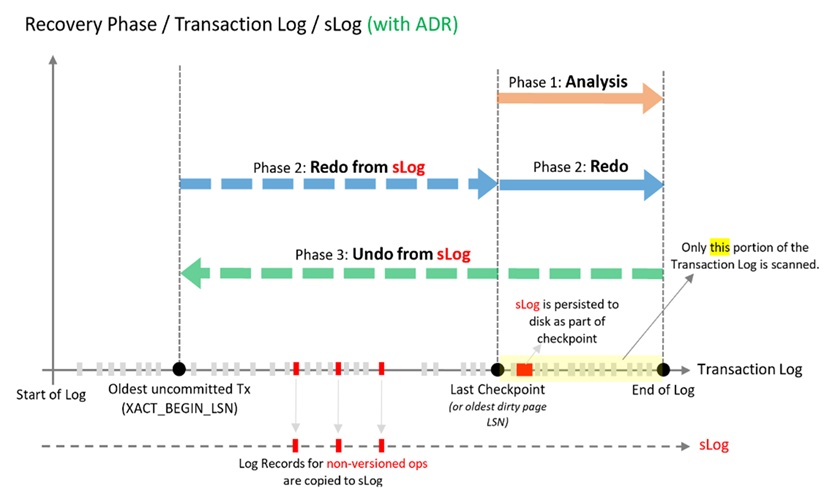
As illustrated in operational deployments, SQL Server scans only a minimal portion of the transaction log during recovery. The undo phase, historically the most time-consuming component, is driven primarily from SLOG, enabling completion in milliseconds rather than minutes or hours.
Simplified Working of ADR Explained
Once ADR is enabled:
- SQL Server maintains row versions
- Previous versions are stored in a memory-optimized log called SLOG
- Rollback becomes a logical operation, not page-by-page undo
📌 As shown in the diagram, SQL Server scans only a small portion of the transaction log, while undo operations are driven from SLOG enabling fast and predictable recovery.
Steps to Enable ADR
ADR is enabled per database and is OFF by default.
SELECT name, is_accelerated_database_recovery_on FROM sys.databases;
ALTER DATABASE MYDEMODB_ADR
SET ACCELERATED_DATABASE_RECOVERY = ON;
ADR Enhancements: It had designed the recovery process by separating logical undo from physical data pages.
Without ADR: A forced rollback of a long-running transaction required approximately 60 minutes of database unavailability. During this window, all dependent applications remained offline, creating a cascading impact across business operations.
With ADR: The identical rollback scenario completed almost instantaneously, measured in seconds rather than minutes. The database remained available throughout, with no perceptible impact on application availability.
- Rollback is almost instantaneous
- Crash recovery is faster and predictable
- Databases come online quickly after restarts or failovers
- Recovery time is no longer tied to transaction size
Similarly, recovery following abnormal shutdown demonstrates ADR’s value proposition. In a production database recovery scenario:
- Analysis phase: 8,162 ms
- Redo phase: 2,593 ms
- Undo phase: 236 ms
- Total recovery time: 12 seconds
This predictability transforms disaster recovery planning from an exercise in pessimistic estimation to one of confident precision.
ADR helps DBAs:
✔ Reduce RTO
✔ Improve availability
✔ Handle heavy transactional workloads
✔ Deliver predictable recovery behavior
Conclusion
The future of database administration with ADR as a feature or strategic reliability should become a standard practice for production SQL Server deployments, supporting mission-critical applications, operating in high-availability configurations, or become the battlecards for customer-centric services. It fundamentally improves our ability to deliver on the promise of high availability in modern database environments. For any DBA serious about operational excellence, it deserves a place in the standard configuration of production SQL Server databases.