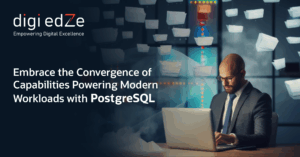
How can enterprises build a database foundation that serves the business today and meet the scaling workloads and technological landscape along with the business that’s intended to become?
When there comes a clarity on this question, then the enterprises will gain a platform that scales with the business, absorbs AI workloads without architectural debt, and delivers the extreme performance that your applications demand. And if not addressed, that;s when the cycle of overprovisioning, unplanned migrations, and cost surprises might repeat again.
This article is a clear framework for leaders who can decide the implementation of the infrastructure based on their business and operational needs.
Evaluation of Oracle Platform for Your Business Excellence
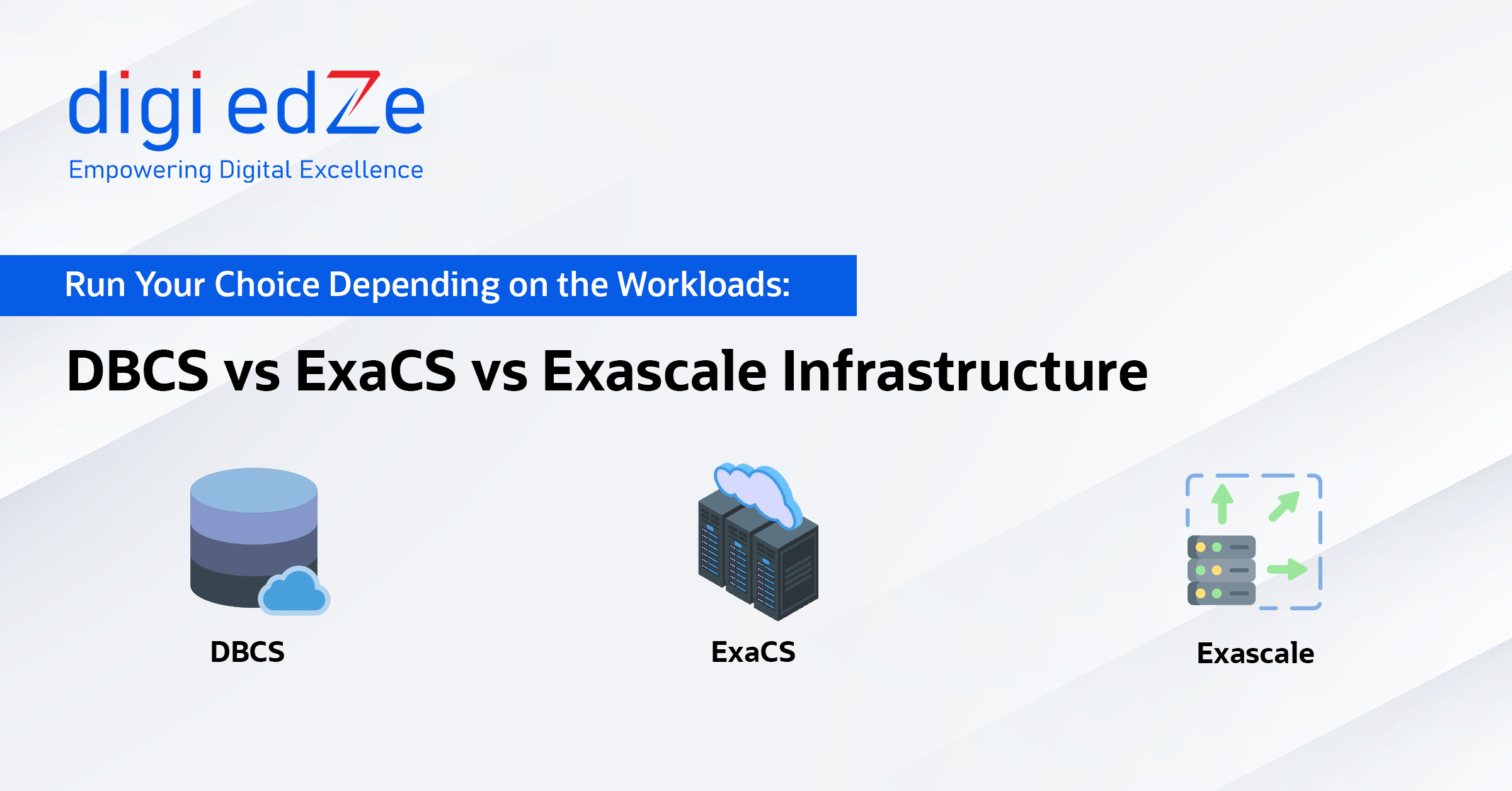
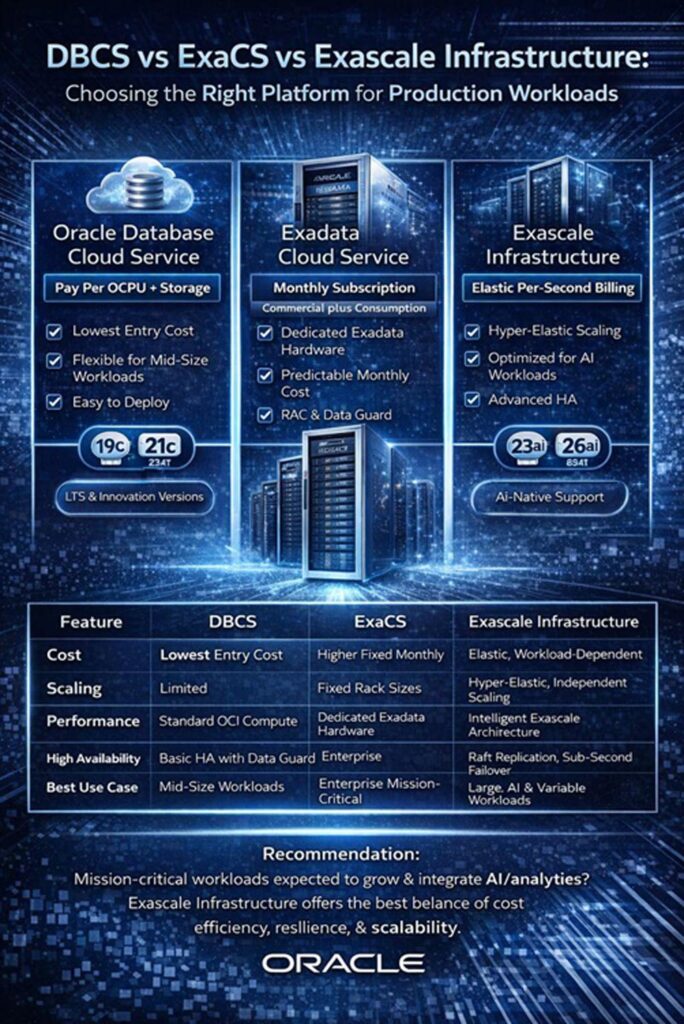
Oracle database cloud portfolio remains uncompromised for businesses with different cost models, operational profiles, and strategic trajectories. Choosing one of them requires a deep dive assessment based on your workloads. The three platforms that Oracle offers are Database Cloud Service (DBCS), Exadata Cloud Service (ExaCS), and newest evolution – Exadata Database service on Exascale Infrastructure. Each has its own advantages on the spectrum of cost efficiency, scalability, and enterprise resilience.
Oracle Database Cloud Service (DBCS)
DBCS runs on standard OCI virtual machines, providing the organizations access to the complete Oracle Database feature set including Enterprise Edition, Real Application Clusters (RAC), and Data Guard.
- Pricing Model: Pay-as-you-go per OCPU/hour plus storage.
- Strengths
- Lowest entry cost.
- Flexible for smaller to medium or predictable OLTP workloads.
- Easy to deploy for dev/test and mid-sized production.
- Limitations
- Performance tuning required for larger workloads.
- HA limited compared to ExaCS and Exascale.
- Online scaling up of CPU resources is possible only on RAC architecture.
Exadata Cloud Service (ExaCS)
ExaCS has a dedicated hardware, the same engineered systems that have enabled world’s most demanding database workloads on-premises in Oracle cloud. Each customer gets their own physical Exadata rack, provisioned exclusively for their workloads.
It offers Smart Scan technology that offloads SQL processing to intelligent storage cells, thus reducing the data that must traverse the network between storage and compute. RDMA over Converged Ethernet (RoCE) enables sub-millisecond storage access latency.
- Pricing Model: Fixed monthly subscription plus consumption.
- Strengths
- Dedicated Exadata hardware.
- Predictable monthly cost.
- Best for enterprises needing RAC, Data Guard, and extreme performance.
- Dynamic scaling of computing resources for business workload.
- Limitations
- Higher upfront cost.
- Less elastic scaling compared to Exascale.
Exascale Infrastructure
The core innovation in Exascale is the separation of compute and storage into independently scalable resource pools. As the traditional Exadata and ExaCS couple database servers to dedicated storage servers in fixed rack configurations, Exascale replaces this with an Exascale Storage Vault. It’s a massive, shared, intelligent storage fabric that serves multiple VM clusters in parallel.
- Pricing Model: Elastic per-second billing.
- Strengths
- Hyper-elastic scaling of compute and storage.
- Exascale Storage Vault optimized for multi-TB to PB datasets.
- Advanced HA with Raft replication and sub-second failover.
- AI-native support for vector search, JSON, and analytics.
- Limitations
- Newer architecture; requires DBA familiarity with Exadata features.
- Costs can spike if workloads are constantly maxed out.
- Available for DB version > 23 ai
Comparing the Three Platforms
| Feature | DBCS | ExaCS | Exascale Infrastructure |
| Cost | Lowest entry cost | Higher fixed monthly | Elastic, workload-dependent |
| Scaling | Limited | Fixed rack sizes | Hyper-elastic, independent scaling |
| Performance | Standard OCI compute | Dedicated Exadata hardware | Intelligent Exascale architecture |
| High Availability | Basic HA with Data Guard | RAC + Data Guard | Raft replication, sub-second failover |
| Best Use Case | Mid-size workloads | Enterprise mission-critical | Large, variable, AI-driven workloads |
Supported Database Versions
Service | Supported Versions | Notes |
|---|---|---|
Oracle Database Cloud Service (DBCS) | Oracle Database 19c, 21c, 23ai | 19c is the current Long-Term Support (LTS) release; 21c is Innovation; 23ai adds AI-native features. |
Exadata Cloud Service (ExaCS) | Oracle Database 19c, 21c, 23ai, 26ai | Supports both LTS and Innovation releases; optimized for RAC, Data Guard, and mission-critical workloads. |
Exascale Infrastructure (ExaDB-XS) | Oracle Database 23ai, 26ai | Designed for AI-native workloads; supports the newest long-term support releases with hyper-elastic scaling. |
Conclusion
The choice depends on priorities:
- DBCS: Choose if the cost is your dominant constraint, workloads are predictable and mid-sized and AI integration is not in your roadmap.
- ExaCS: Implement for high performant workloads where dedicated hardware is a governance or regulatory requirement. Achieve stability and predictability of the subscription model on enterprise-class infrastructure that becomes the benchmark for mission-critical Oracle workloads.
- Exascale Infrastructure: When your workloads are growing, elasticity has operational and financial value, and AI integration is in the loop. The entry cost is accessible, cloud is scalable, and Oracle’s most significant database innovation investments are being delivered here first.
Recommendation: For mission-critical workloads expected to grow or integrate AI/analytics, Exascale Infrastructure offers the most strategic balance of cost efficiency, resilience, and scalability.
Collaborate with us to evaluate, implement, and optimize your database platforms with Oracle potent infrastructure solutions that redefine your future landscape.