
Enterprises don’t have an AI problem. They have an integration, governance, and sovereignty problem — and a fleet of agents won’t fix it. A brain will.
Walk into almost any large enterprise today and you will find AI everywhere. It is embedded in the CRM. It is suggesting replies in the service desk. It is forecasting the finance close. It is tagging anomalies in the cloud cost tool. By every surface measure, these organisations have “adopted AI.”
And yet, ask the CIO a simple question — “point me to one line on the P&L that has moved because of it” — and the room goes quiet.
This is the paradox at the heart of enterprise AI in 2026. Adoption is near-universal. Value is not. The technology works in the demo and stalls in production. The reason is almost never the model. It is everything around the model — and that is exactly the problem digi edZe was built to solve.
The real enterprise challenge isn't intelligence. It's everything between the islands of it.
The first wave of enterprise AI gave every team its own intelligence. The unintended consequence is agentic sprawl: dozens of point solutions and copilots, each with its own memory, its own context, its own implicit policy, sitting on top of a stack of disconnected systems.
When we sit with enterprise leaders across India and the Middle East, the same five challenges surface every single time:
- Fragmentation. The average large enterprise runs hundreds of applications, and only a fraction are integrated. AI bolted onto that estate inherits the fragmentation — and amplifies it. An agent that can’t see the whole picture makes confident decisions on partial truth.
- No shared memory. Each tool reasons over its own brittle context window. There is no single, versioned version of enterprise truth that every agent can draw on. So the finance copilot and the ops copilot can give two different answers to the same question — and both can be wrong.
- Governance and accountability. When an autonomous system takes an action, who is accountable? Guardrails retrofitted at the prompt level are guardrails you cannot audit. Autonomy without attribution is not autonomy — it is liability.
- Runaway economics. Agents are not free. An unbounded multi-agent system can quietly burn six figures in tokens a month. A meaningful share of cloud budgets is already wasted before AI enters the picture. Without unit-cost discipline engineered in from day one, “agentic” becomes a line item nobody can defend.
- Sovereignty. This is the one that has moved fastest. Every regulated enterprise now has to answer three questions it could previously ignore: Where does our data live? Which model is reasoning over it? And where does that thinking physically happen? “On a US-hosted platform, we think” is no longer an acceptable answer.
You cannot solve these five problems by adding more agents. More agents make all five worse. You solve them by building the thing that should have come first.
The answer: turn the enterprise into the agent
The instinct of the market has been to ask, “how do we deploy more agents, faster?”
digi edZe asks the inverse: “how do we build a single, sovereign cognitive layer that turns the entire enterprise into one coherent, governed, intelligent system?”
We call that layer the Sovereign Enterprise Digital Brain. It is not a product you install next to your agents. It is the continuous reasoning fabric that sits beneath every agent and above every system — perceiving, remembering, reasoning, and acting as one mind, with one memory, under one policy, accountable through one voice.
The dZsuite is how we operationalise that brain. And the shift it represents is fundamental:
| The point-tool enterprise | The Sovereign Enterprise Digital Brain |
| Many copilots, each with its own context | One brain, one shared enterprise memory |
| Intelligence bolted onto fragmented systems | A native cognitive layer that spans the estate |
| Guardrails retrofitted at the prompt | Policy and governance built into the architecture |
| Per-seat, per-token cost that scales out of control | Outcome-linked economics: MTTR, FinOps savings, autonomous coverage |
| Sovereignty inherited from someone else’s platform | Sovereignty as a first-class design constraint |
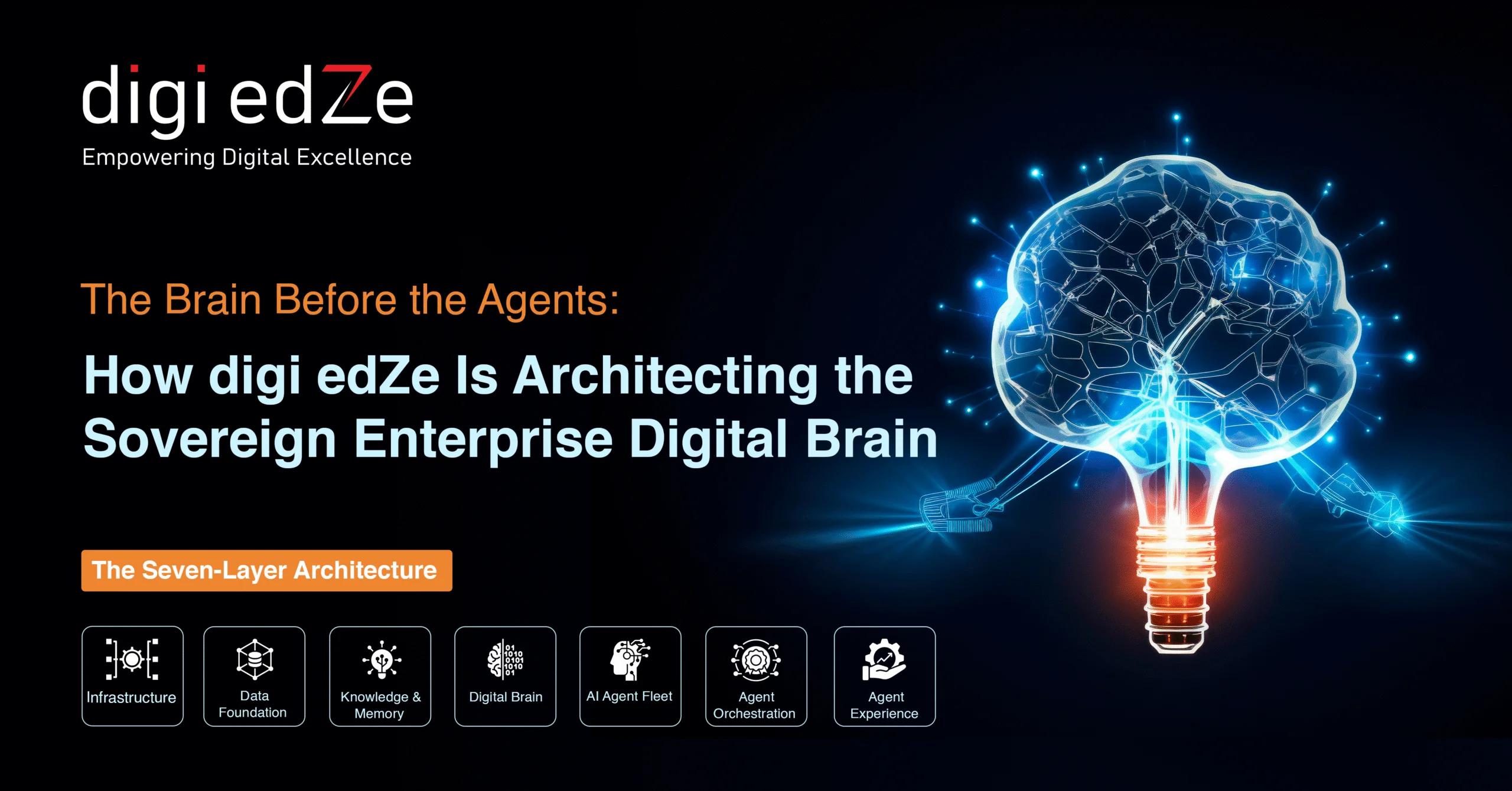
The 7 layers of the Sovereign Enterprise Digital Brain
We didn’t draw these seven layers on a whiteboard. We reverse-engineered them from how cognitive systems actually work — and from more than two decades of running mission-critical infrastructure for enterprises across India and the GCC. Each layer is observable, governable, and deployable wherever sovereignty demands.
L1 — Infrastructure | The Body. The sovereign substrate. Multi-cloud (OCI, AWS, Azure, GCP), on-premise, private VPC, and fully air-gapped — eight deployment models in all. Sovereignty doesn’t begin with a policy document; it begins with where the silicon physically sits. L1 is where that choice is made and enforced — so a bank, an insurer, or a national platform can run the same brain inside the perimeter their regulator requires.
L2 — Platform | The Brainstem. The runtime and control plane: the connectors and integration fabric that wire the brain into ServiceNow, SAP, Salesforce, Oracle Fusion, and the rest of the estate. This is the layer that ends fragmentation — every system becomes a sense organ and an actuator of one brain, not another island.
L3 — Data & Sensing | The Senses. How the brain perceives. Streaming and batch pipelines, lakehouse, telemetry, and lineage. Two dZsuite products live here:
- dZlens — the brain’s eyes: full-estate observability and multi-cloud cost and resource visibility.
- dZtrace — distributed tracing, dependency mapping, and the audit lineage that makes every downstream action explainable.
L4 — Knowledge & Memory | The Hippocampus. Vector stores, knowledge graphs, runbooks, regulatory corpora, and historical incident memory — shared, versioned, governed. This is the layer that solves the no-shared-memory problem directly: the difference between agents that each remember their own fragment and an enterprise that finally has one memory.
L5 — Reasoning | The Cortex. The cognitive core: planners, evaluators, and retrieval-augmented reasoning over enterprise memory. This is where model sovereignty becomes real. Our own open-weight model, JanMitra 4.49B (published on Hugging Face), is a deliberate signal of that commitment — reasoning hosted inside the enterprise perimeter, fine-tuned to its domain, rather than rented by the token from outside it.
L6 — Orchestration & Action | The Motor Cortex. Multi-agent coordination, workflow choreography, human-in-the-loop checkpoints, and governed execution — with policy guardrails baked in at the orchestration layer rather than bolted onto the prompt. This is where the dZsuite’s operational agents do real work:
- dZops — autonomous IT operations: Triage → Diagnose → Fix → Verify → ITSM, closing L1/L2 work without a human in the loop.
- dZsre — autonomous Site Reliability Engineering: reliability, incident response, and error-budget management.
- dZopti — autonomous optimisation and multi-cloud FinOps: the product that brings runaway economics back under control and makes the rest of the brain pay for itself.
- dZshield — autonomous security and compliance posture management (CSPM), tuned to regulated-industry control frameworks.
L7 — Experience | The Voice. The conversational surface where humans and the brain meet — and where Chat4ED lives.
Chat4ED: the Conversational Business (Decision) Intelligence layer
Most “agentic” stories stop at automation: the agent does the task. The harder and far more valuable layer is decision intelligence — where the system explains the situation, surfaces the trade-offs, recommends an action, and tells you why.
That is what Chat4ED is built to do at L7. It is not a chatbot stapled to a dashboard. It is the natural-language decision surface of the entire Digital Brain — in English, Hindi, Arabic, and Urdu — where a CIO can ask “why did our OCI spend jump 14% last week, and what did the brain already do about it?” and get an answer grounded in L3 telemetry, L4 memory, L5 reasoning, and L6 action, with the full audit trail attached.
Automation tells you the task is done. Conversational decision intelligence tells you whether it should have been done at all — and keeps a human firmly in command of an autonomous enterprise. This is the layer that turns a system you merely operate into a system you can interrogate, trust, and answer for.
The Sovereignty Spine: the vertical that holds it together
The seven layers are the horizontal architecture. What makes it sovereign is the spine that runs vertically through all of them:
- Data sovereignty (L3–L4) — your data stays where your regulator says it must.
- Model sovereignty (L5) — your reasoning runs on models you can host, inspect, and fine-tune — JanMitra being the first.
- Inference sovereignty (L1–L2) — your thinking happens where you choose, up to and including a fully air-gapped facility.
- Decision sovereignty (L6–L7) — every autonomous action is policy-bound, attributable, and reversible, and every recommendation is explainable through Chat4ED.
This is not a compliance afterthought. It is the entire reason the architecture exists. Under India’s DPDP Act, the KSA PDPL, the UAE AI Strategy 2031, and the EU AI Act, an enterprise that cannot say where its data lives, which model is reasoning over it, and who is accountable for the action it took does not have an AI strategy. It has an exposure.
Governance, in our world, is not a one-time stage in a project plan. It is a layer that is always on — delivered through dZGaaS (Governance-as-a-Service) and wrapped, end to end, in the managed-service delivery model we call dZEaaS.
Built for the enterprise it actually serves
Most agentic reference architectures were written for organisations that can absorb per-seat, per-token economics and are comfortable trusting their cognition to a platform hosted on another continent. That is a fine fit — for some.
It is not the fit for the BFSI, insurance, telecom, energy, and government buyers we serve across India and the GCC, who need three things that the “more agents, faster” model struggles to give them:
- Predictable TCO — fixed-outcome managed services, not a token meter that can burn six figures before anyone notices.
- Sovereign deployment as the default — on-prem and air-gapped as standard options, not premium exceptions.
- Outcome accountability — measured in MTTR reduction, FinOps savings, and autonomous coverage, not in seats provisioned.
The Sovereign Enterprise Digital Brain is engineered for exactly those realities, from L1 up.
A blueprint enterprises can actually adopt
A brain is only useful if an enterprise can grow into it. We deploy the dZsuite along a phased path that mirrors how our teams engage in the field:
- Discover — an AI-readiness and CloudSecure assessment that maps the data estate, the agentic use-case backlog, and the current governance posture.
- Design — a reference architecture for the customer’s own Digital Brain, with candidate use cases ranked by business value and feasibility.
- Deploy — a focused 90-day rollout of two or three high-value capabilities from the dZsuite, instrumented end-to-end for governance and cost from day one.
- Scale — federation across business units, with continuous FinOps optimisation through dZopti and policy evolution through dZGaaS.
You do not buy the whole brain on day one. You start with the layer where the pain is sharpest — usually observability, operations, or cost — and you grow the cognition outward.
The brain has to come before the agents
The analysts agree on the destination. McKinsey, Gartner, and IDC all point to the same horizon: within the next two to three years, autonomous agents will execute a meaningful share of routine knowledge work in every large enterprise.
The open question was never whether you will run agents. It is what they will run on.
An enterprise full of capable agents with no shared brain, no shared memory, no sovereign reasoning, and no single accountable decision surface is not an intelligent enterprise. It is a faster, more expensive version of the fragmentation it already had.
So we made a different bet at digi edZe. Build the brain first — and build it for the enterprise it actually serves, in the country it actually operates in.
The agents will come. The real question is whether they will think with one mind, remember one truth, obey one policy, and answer to one accountable voice.
At digi edZe, that mind has seven layers, a sovereign spine, and a name: the Sovereign Enterprise Digital Brain.