Many enterprises invest into autonomous databases on dedicated infrastructure as it brings operational excellence, resilience, and delivers high performance across all the workloads. Most of the times such infrastructure might be running smoothly until the questions arise because of its complexity or lack of expertise:
- How will the issues within the system be identified?
- How will they be informed whether Oracle operations work on the database?
- How will they know if the issue has been resolved?
- Finally, how can one track password or certificate expiry?
Although Autonomous Database is a fully managed service, there are still responsibilities that persist such as resetting the admin password or rotating certificates. In addition, some system events may not require action from the enterprise side, but still need visibility into them. Missing or delaying action on certain events severely impacts databases or applications.
To address this, Autonomous Database provides a rich set of Oracle Cloud Infrastructure (OCI) Events that help enterprises to detect critical situations early and take proactive steps to maintain high availability.
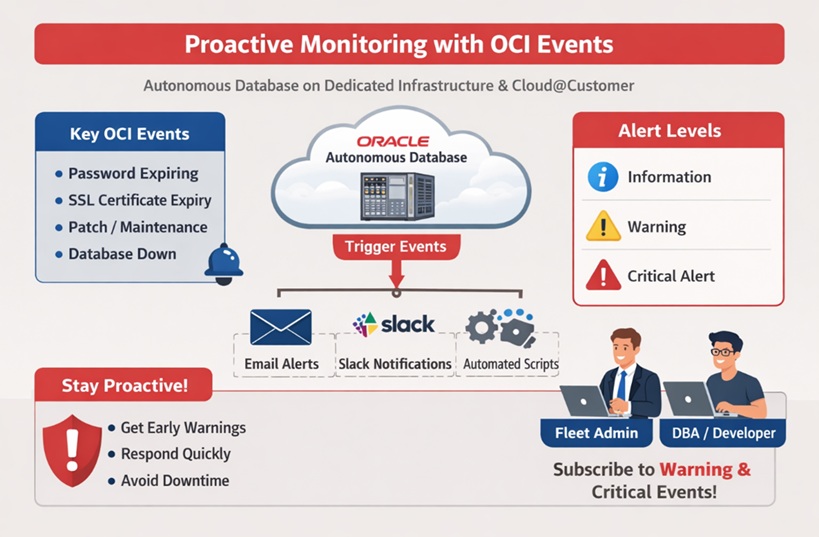
What are OCI Events?
OCI Events are structured messages that represent changes in resources. They allow you to automate actions based on the state of your cloud resources. Using event rules, you can route these events to OCI services such as Notifications, Streaming, or Functions.
Let’s dive deep into the most important events related to Autonomous Database on Dedicated Infrastructure (ADB-D) and Autonomous Database on Cloud@Customer (ADB – C@C) that every enterprise should consider subscribing for.
OCI Event Resources for ADB-D and ADB-C@C
OCI Events for ADB-D and ADB-C@C are grouped under the following five resource types:
- Exadata Infrastructure / Cloud Exadata Infrastructure
- Autonomous VM Cluster / Autonomous Cloud VM Cluster
- Autonomous Container Database
- Autonomous Database
- Autonomous Data Guard
Exadata Infrastructure and Autonomous VM Cluster events apply to ADB-C@C, while Cloud Exadata Infrastructure and Autonomous Cloud VM Cluster events apply to ADB-D. The remaining three resource types are common to both environments.
Based on the individual responsibilities, you may choose to subscribe to all or only a subset of these resources. But here’s what we recommend:
- Fleet administrators subscribe to events for Exadata Infrastructure, Autonomous VM Cluster, and Autonomous Container Database.
- Developers and DBAs subscribe to events for Autonomous Database.
ADB-D emits more than 100 OCI events, so you do not necessarily need to subscribe to all of them.
Categories of ADB-D Events
All ADB-D events fall into two main categories:
- Events triggered by OCI API calls
- Events triggered by system state changes not related to API calls
For API-driven operations, the service publishes a BEGIN event when the call is made and an END event when the operation completes or fails. These events contain all the information required to identify the resource and the outcome of the operation.
Most ADB-D events belong to this category. Depending on your use case, you can subscribe selectively. For example, you may subscribe to the Create Autonomous VM Cluster – End event to automatically trigger a function that creates an Autonomous Container Database in that VM cluster. This removes the need to manually monitor the console and wait for resource creation.
Generic Information, Warning, and Critical Events
ADB-D also publishes Information, Warning, and Critical events for all five resource types.
- Critical events indicate that your system is already impacted and require immediate attention.
- Warning events signal potential issues that may become critical if no action is taken.
- Information events provide useful updates that you should be aware of.
Examples include admin password expiry, SSL certificate expiry, and reminders to rotate certificates before they expire. These generic events also include operation-specific sub-events that are raised when Oracle operations detect and resolve system issues.
We strongly recommend subscribing to Warning and Critical events relevant to your role.
Conclusion
OCI Events are structured notifications that reflect changes in your cloud resources and enable automation across your tenancy. ADB-D emits events in response to both OCI API calls and internal system state changes.
While API-based events can be subscribed to as needed, subscribing to Critical and Warning events is essential for maintaining a highly available environment. Fleet administrators should focus on infrastructure-level resources, while DBAs and developers should prioritize Autonomous Database events.
Proactively acting on these events is a key step toward ensuring the reliability and availability of your Autonomous Database environment.